Who actually performs your hair transplant? The critical difference between surgeon-led and technician-run procedures — and why it determines your result.
Of all the questions a hair transplant patient should ask before booking, this is the most important: who will actually perform the surgery? Not who the clinic names on its website. Not who appears in the before/after photos. Who will be holding the instruments when your follicles are being extracted, your channels are being created, and your grafts are being implanted?
Two Completely Different Models
The hair transplant industry operates on two fundamentally different models, and patients rarely know which one they are booking until they arrive at the clinic.
Model A: Surgeon-Led (Hairmedico)
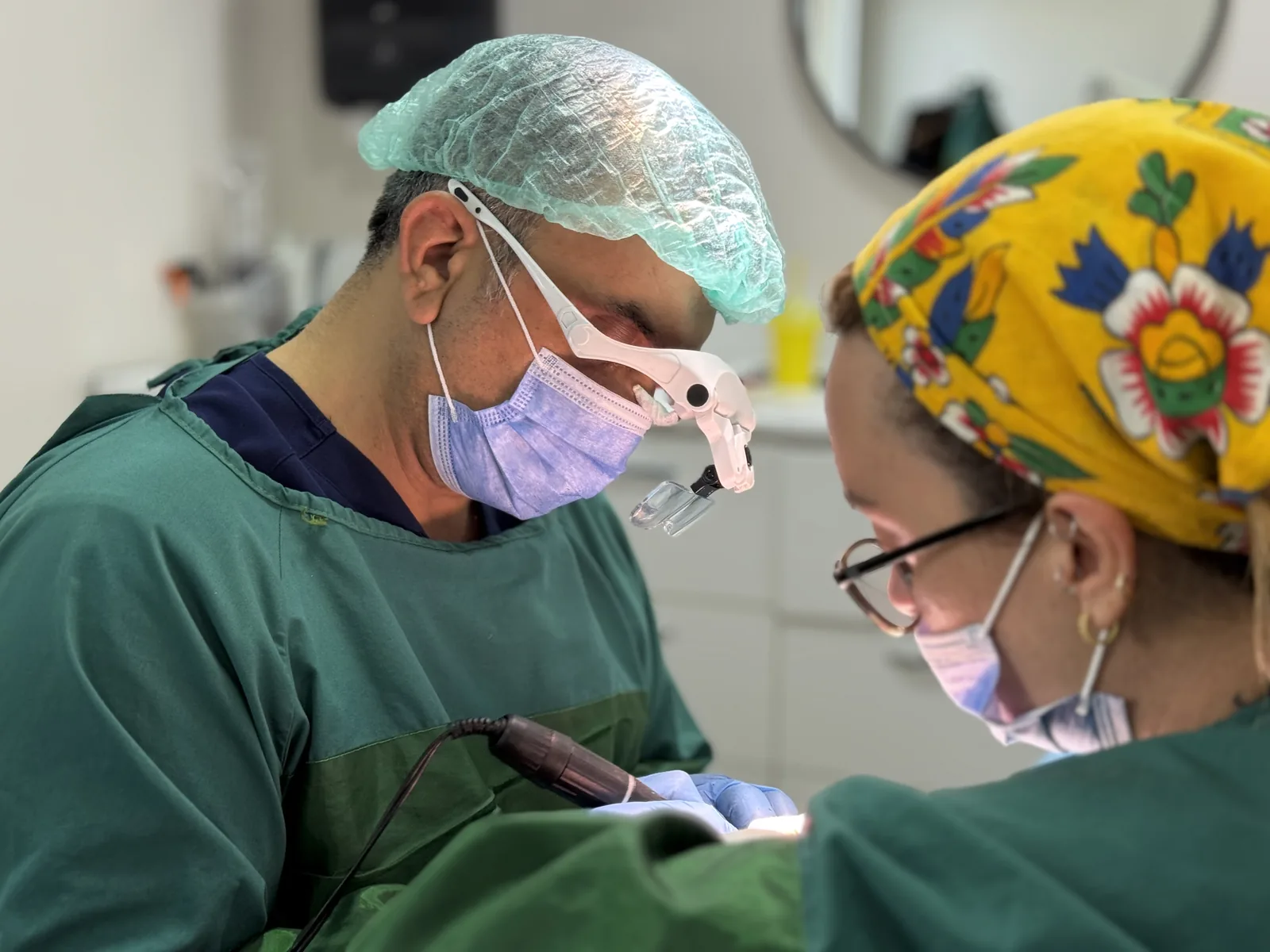
The named surgeon leads every critical step of the procedure, personally performing the extraction in VIP and the implantation too in DHI VIP. Involvement follows the package, from Gold to VIP. The surgeon is physically present for the procedure, personally performing the steps included in each package.
Model B: Technician-Led (Most High-Volume Clinics)
The named surgeon may be present for a consultation, the hairline design, and perhaps the first few minutes of the procedure. Extraction, channel creation and implantation are performed by trained technical staff — not licensed physicians. The surgeon "supervises" in a general sense while operating on other patients in adjacent rooms.
Both models are legal under Turkish regulations. Model A produces consistently better results on every measurable quality dimension. Understanding which model you are booking requires asking one specific question directly.
Before exploring who performs the surgery, understanding exactly what hair transplant surgery involves helps frame why the operator matters so much.
Why It Matters: The Clinical Evidence
Transection rate: The proportion of follicles permanently damaged during extraction. Experienced surgeons: 2–5%. Undertrained technicians: 10–30%. In a 3,000-graft session, the difference between 3% and 20% transection is 510 permanently destroyed grafts — grafts that will never produce hair regardless of how many were claimed.
Channel creation: The angles, directions and depths of recipient channels determine whether the result looks natural or artificial. This requires aesthetic judgment and anatomical training that technicians lack. A beautifully natural hairline cannot be produced by following a mechanical protocol.
Hairline design: Some clinics delegate hairline design to "patient coordinators" who are not medical professionals. The decision about where your hairline sits and what shape it takes will affect your appearance for life — it requires a physician's aesthetic judgment and medical training.
Complication management: During surgery, unexpected anatomy, unusual bleeding patterns, follicle grouping variations — an experienced surgeon recognises and adapts to these in real time. A technician cannot.
How to Ask — and What to Accept as an Answer
The question to ask every clinic: "Does Dr. [name] personally perform the extraction, channel creation and implantation — or are any of these steps performed by other staff?"
Acceptable answers: "Yes, Dr. [name] personally performs all steps." (Confirm in writing if possible.)
Unacceptable answers: "Dr. [name] supervises the procedure." / "Our team of specialists performs the surgery." / "Dr. [name] is present throughout." None of these confirm personal performance.
Red flags: Evasive responses. Descriptions of "teams" without specifying who does what. Claims that "our technicians are trained to surgeon standard" — no amount of training makes a non-physician a physician.
Dr. Arslan Musbeh's full background and personal surgical approach are detailed at Hairmedico About Us.
Five Verification Questions to Ask Before Booking
- "Does the surgeon personally perform extraction?" — Extraction is where transection damage occurs. This step must be surgeon-performed for maximum graft survival.
- "Does the surgeon personally create the recipient channels?" — Channels determine naturalness. This is the most aesthetically critical step.
- "Does the surgeon personally implant the grafts?" — Implantation angle and depth are set here. Must be surgeon-performed for consistent results.
- "How many patients does the surgeon treat per day?" — The answer to this question determines whether personal performance of all steps is even physically possible.
- "Can I meet the surgeon before booking — not a coordinator?" — Pre-booking access to the surgeon (via video call or in-person) confirms their availability and engagement.
View Hairmedico all-inclusive package details at hairmedico.com/price.
Common questions
Who performs hair transplant at Hairmedico?
Every procedure is surgeon-led by Dr. Arslan Musbeh, with his personal involvement increasing by package tier — extraction and channel-opening himself in VIP. Involvement follows the package, from Gold to VIP.
What is surgeon-led hair transplant?
The named surgeon physically performs all critical surgical steps. Not supervision. Not delegation. Personal performance of extraction, channel creation and implantation.
Why does surgeon-led surgery produce better results?
Experienced surgeons achieve 2–5% transection vs 10–30% for technicians. They bring aesthetic judgment to channel creation and hairline design that technical staff cannot replicate.
Related articles
- Why Surgeon-Led Hair Transplants Deliver Bett
- Typically One Patient Per Day: The Secret Behind Natura
- Technician vs Surgeon Hair Transplant: Why th
References & sources
- International Society of Hair Restoration Surgery. 2022 Practice Census results. 2022. ishrs.org
- Cranwell W, Sinclair R. Male androgenetic alopecia. Endotext NCBI, 2023. https://www.ncbi.nlm.nih.gov/books/NBK278957/
- NHS. Hair loss treatment overview. NHS UK, 2024. https://www.nhs.uk/conditions/hair-loss/