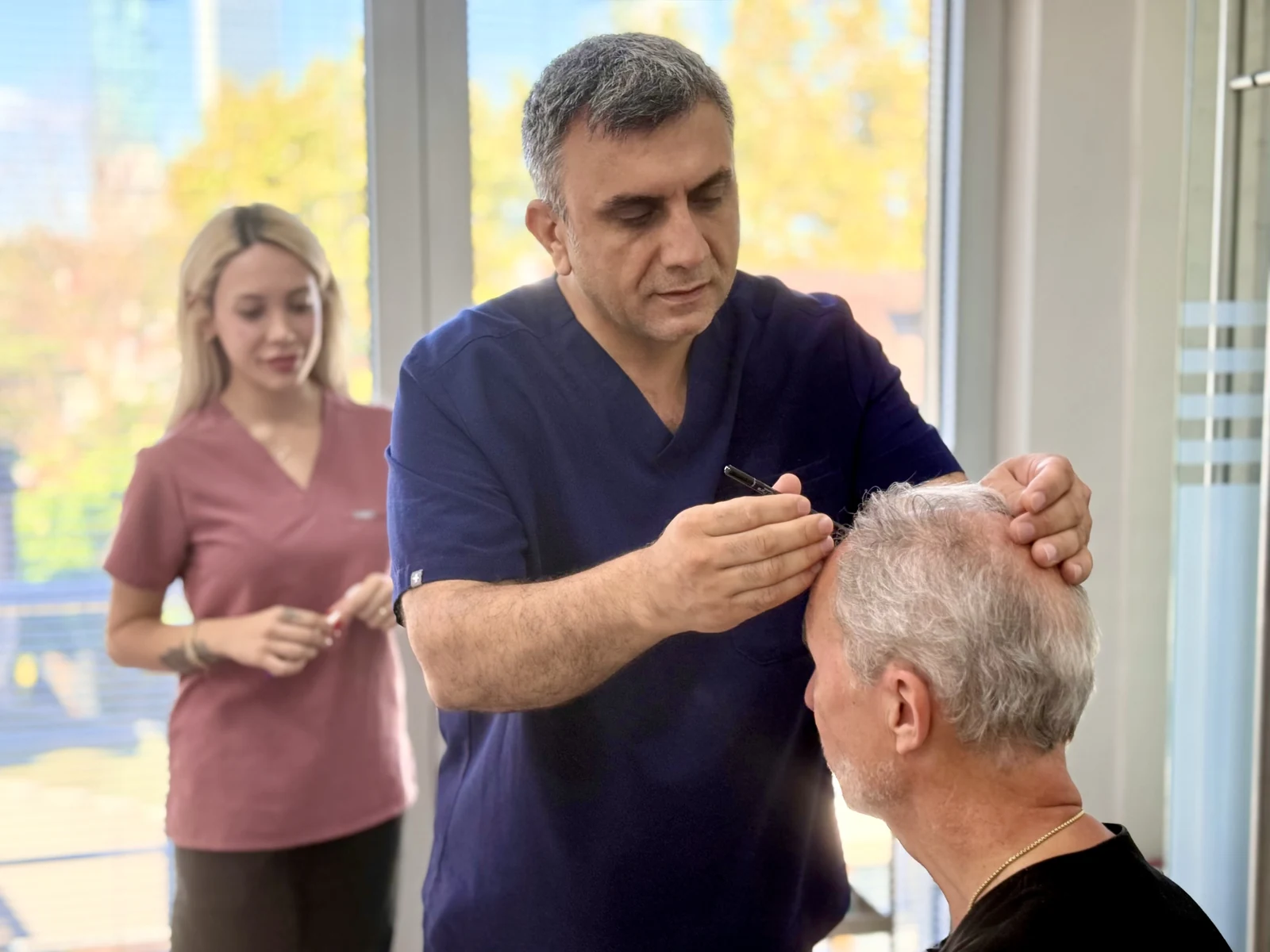
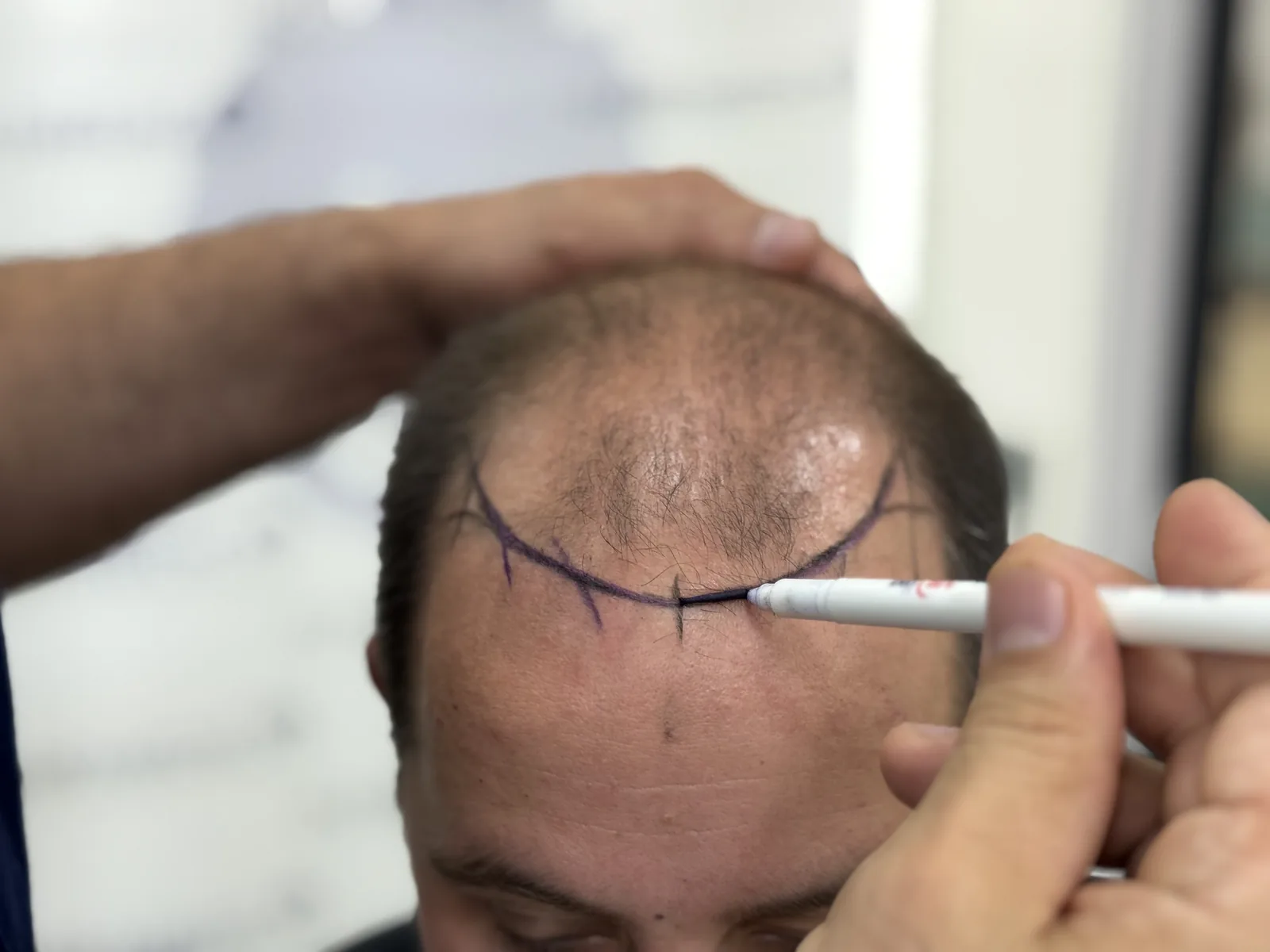
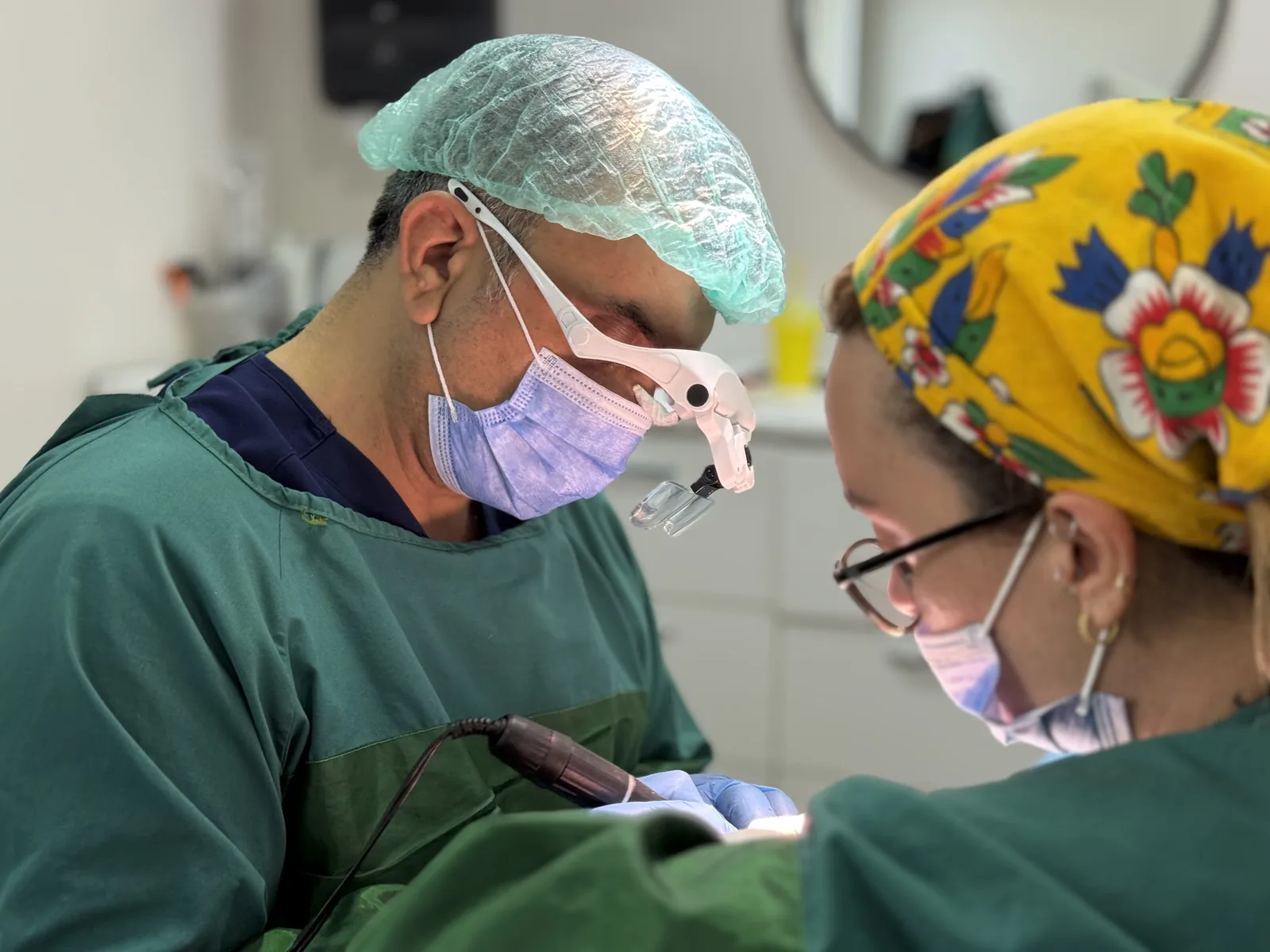
Dr. Arslan personally leads every package, performing the channel-opening incision himself in Gold and VIP. You are the only patient in the clinic that day.
The Norwood-Hamilton scale (commonly called the Norwood scale) is the standard classification system for male pattern hair loss. Developed by Dr. James Hamilton in the 1950s and revised by Dr. O'Tar Norwood in 1975, it categorises male androgenetic alopecia into seven stages based on the pattern and extent of hair loss.
At Hairmedico, Dr. Arslan Musbeh uses the Norwood scale as one component of a comprehensive assessment — alongside donor density, hair calibre, age and projected future loss — to determine transplant candidacy and technique selection.
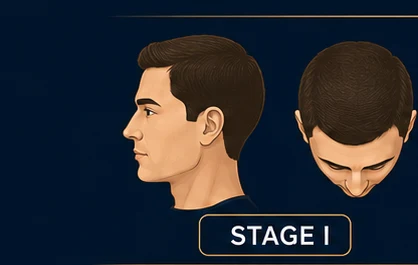
Full hairline with no recession. Typically not a candidate for hair transplant. Monitoring recommended.
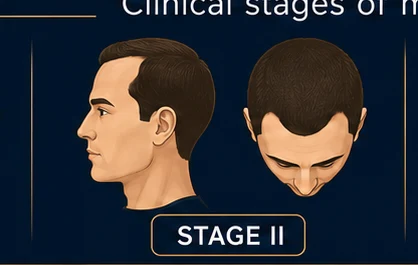
Norwood II — Slight temporal recession
Minor recession at the temples. Early hairline work may be considered. 800–1,500 grafts typically sufficient. DHI is commonly recommended for precision hairline work at this stage.
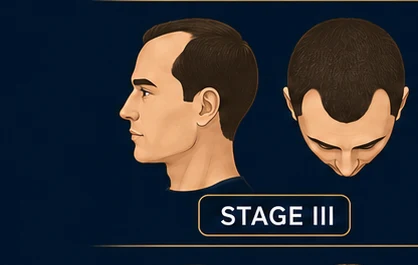
Norwood III — Moderate recession
More pronounced temporal recession forming a distinct M or V shape. 1,500–2,500 grafts. The most common stage at which patients first seek treatment. Also includes Stage IIIv — vertex (crown) thinning with minimal hairline recession.
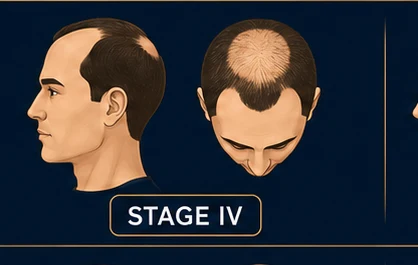
Norwood IV — Significant recession + crown
Marked hairline recession combined with crown thinning. The bridge of hair between front and crown narrows. 2,500–3,500 grafts. Sapphire FUE or DHI depending on priority area.
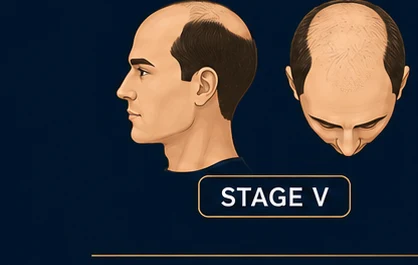
Norwood V — Extensive loss
The bridge between front and crown is diminished or absent. Hair loss affects most of the top of the scalp. 3,500–5,000 grafts. Requires careful donor zone planning — Algorithmic FUE™ methodology is particularly important at this stage.
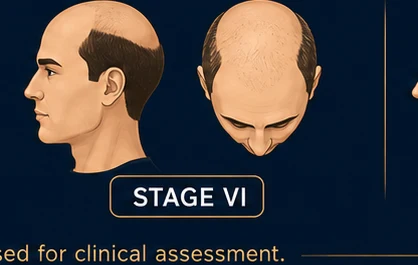
Norwood VI — Advanced loss
Front, top and crown areas extensively bald. Only a horseshoe band of hair remains at sides and back. 4,500–6,000 grafts. Donor supply becomes the limiting factor. Dr. Arslan assesses donor viability carefully before accepting these cases.
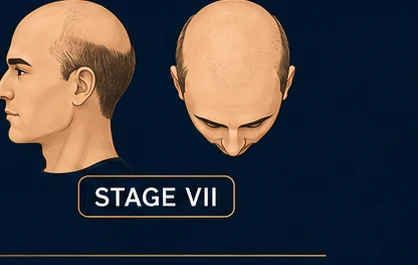
Norwood VII — Severe loss
Only a thin band of hair at the sides and back. Very limited donor supply. Transplant may provide partial restoration — the extent is determined by what the donor zone can safely provide without visible depletion.
Important: Norwood stage alone does not determine candidacy. Donor density, hair calibre, age and future loss trajectory are equally critical. A Norwood V patient with dense donor hair may be a better candidate than a Norwood III with sparse donor density. Send photographs for Dr. Arslan's personal assessment.
Approximate Graft Requirements by Stage
These are general ranges — individual requirements depend on head size, area of coverage, hair calibre and desired density:
Precise graft requirements are determined by Dr. Arslan after reviewing your photographs. View real results by Norwood stage, and explore the package options for your graft count range.
Frequently Asked Questions
What Norwood stage am I?
The most reliable way to determine your Norwood stage is to submit photographs of your front hairline, crown and sides to Dr. Arslan for a personal assessment. He will identify your stage and provide a graft estimate within 24 hours.
At what Norwood stage should I get a hair transplant?
There is no universal answer — it depends on whether your loss has stabilised, your age, and your donor density. Most patients have their first procedure at Norwood III–IV. Earlier intervention (Norwood II) may be appropriate if the recession is causing significant concern, but requires careful planning to avoid creating an unnatural result as loss continues.
Can Norwood VI or VII patients get a hair transplant?
Yes, but with realistic expectations about coverage. At Norwood VI–VII, donor supply is the limiting factor. Dr. Arslan assesses every case individually and only accepts patients where a satisfactory result is achievable without depleting the donor zone.
Who developed the Norwood scale, and why is it sometimes called the Norwood-Hamilton scale?
The classification was originally developed by Dr. James Hamilton in the 1950s and was revised into its current seven-stage form by Dr. O'Tar Norwood in 1975 — which is why it is formally known as the Norwood-Hamilton scale. At Hairmedico, Dr. Arslan Musbeh uses it as one part of a broader assessment alongside donor density, hair calibre and age.
Is Norwood I hair loss a candidate for a hair transplant?
No. Norwood I describes a full hairline with no recession, so it is typically not a candidate for a hair transplant. Monitoring is recommended at this stage instead.
What is Norwood IIIv, and how is it different from a standard Norwood III?
Norwood IIIv is a variant of Stage III in which the crown (vertex) is thinning while the hairline itself shows minimal recession — unlike standard Norwood III, where loss is concentrated at the temples in an M or V shape. Because more scalp area is affected, Norwood IIIv typically needs a graft count closer to Norwood IV's 2,500–3,500 range rather than standard Norwood III's 1,500–2,500.
Does a higher Norwood stage automatically mean I'm a worse transplant candidate?
Not necessarily. Donor density, hair calibre, age and future loss trajectory matter as much as the Norwood stage itself — a Norwood V patient with dense donor hair can be a better candidate than a Norwood III patient with sparse donor density. Dr. Arslan reviews these factors together rather than relying on Norwood stage alone.
Does the recommended transplant technique change depending on my Norwood stage?
Yes. DHI is commonly used for precision hairline work at Norwood II, Sapphire FUE or DHI is chosen at Norwood IV depending on the priority area, and Algorithmic FUE™ methodology becomes particularly important at Norwood V for careful donor zone planning. Dr. Arslan confirms the exact technique after reviewing your photographs.
After researching countless clinics, I specifically didn't want a "hair mill." Dr. Arslan is hands-on throughout the entire process. I came from Australia and the experience was seamless.
Dr. Arslan was present throughout the surgery and personally performed the majority of key procedures. His professionalism and dedication made all the difference.
I already see good hair growth after only 17 weeks. The professionalism of the team and facilities was excellent.
Dr. Arslan was incredibly professional — he explained all procedures clearly. The clinic was spotless and the staff were super friendly.
From first contact, communication was prompt, transparent and efficient. My expectations were surpassed by the services and attention I received.
After 5 years of research I chose Hairmedico. Even on a basic package, Dr. Arslan performed the critical incision phase himself.