
Overview
Hair
Transplant
Turkey

Surgeon-led hair restoration clinic in Levent, Istanbul since 2005.

Explore all →
Lorew Paris
Premium hair care by Hairmedico
Discover →
Confidential · Free
Bespoke Assessment by Dr. Arslan

Send 3–5 photographs. Personal response within 24 hours — no intermediaries.

Request Now →
17+
Years
1
Patient/day
Surgery
Techniques
& Procedures

Selected for your specific hair loss pattern and aesthetic goals.

FUE vs DHI →
Interactive Tool
Which Technique Is Right for You?

FUE, DHI or Algorithmic FUE™ — Dr. Arslan recommends based on your photographs and Norwood stage.

Get Assessment →
Try Graft Calculator →
Why Turkey
World-class
surgery.
Local price.

FUE Europe member. Ministry of Health accredited clinic. Levent, Istanbul — 60–80% less than UK or US.

View Package →
The Surgeon
Dr. Arslan
Musbeh

FUE Europe member. Ministry of Health accredited. 17+ years. 3,000+ personal procedures. One patient per day.

Full Profile →
Dr. Arslan · Istanbul
"One patient. One day. No exceptions."

One patient a day, every package surgeon-led. Every result personally accountable.

Read Philosophy →
17+
Years
3,000+
Cases
FUE
Europe
Pricing
All-Inclusive
Packages

No hidden costs. Hotel, transfers, surgery and aftercare in one price.

View Pricing →
Most Chosen
VIP

Silver · Gold · VIP — 5-star hotel · Airport transfers · PRP included

View Pricing →
Graft Calculator →
Results
Real
Before
& After

Every case personally overseen by Dr. Arslan Musbeh, from consultation to results.

Full Gallery →
Non-Surgical
Beyond
Surgery

Not every case needs a transplant. Medical treatments, therapies and specialist options.

Overview →
Medical Education
Learn
before
you decide.

Guides, tools and expert content — written by Dr. Arslan Musbeh.

All Articles →
Bespoke Assessment WhatsApp
Hair Transplant
Hair Transplant Turkey
Techniques
Techniques
Procedures
Why Turkey
Country Comparisons
Non-Surgical
Medical Treatments
Learn
Guides & Tools
Clinic Dr. Arslan Musbeh Pricing & Packages Before & After About Hairmedico Contact
FUE Europe Member
1 Patient / Day
250+ Physicians Trained
Hairmedico›Hair Transplant›Alopecia Hair Transplant
Medical Guide · Alopecia Types

Alopecia & Hair Transplant — Which types qualify?

Androgenetic, traction and scarring alopecia each respond differently to transplant surgery. Candidacy depends on the type and activity of your alopecia, at least 12 months of confirmed stability, and adequacy of the donor zone — assessed personally by Dr. Arslan Musbeh.

Alopecia areata hair loss scalp — hair transplant candidacy assessment Hairmedico Istanbul

Types of Alopecia — What Matters for Surgery

Alopecia is a broad term covering any condition causing hair loss. The surgical approach and expected outcomes differ significantly depending on the type. The three most relevant to hair transplant surgery are androgenetic alopecia, traction alopecia and scarring alopecias.

Androgenetic Alopecia (AGA)

By far the most common form. DHT-driven miniaturisation of follicles in genetically susceptible zones. FUE and DHI transplant surgery works most reliably with AGA — donor follicles from the permanent zone are DHT-resistant and will not undergo the same miniaturisation after transplantation. The key conditions: the loss must be stable, and donor density must be adequate. Most Hairmedico patients have AGA.

Surgery does not stop AGA progression in areas that are not transplanted — native hair next to the new grafts can keep thinning from DHT over the following years. This is why Dr. Arslan designs the hairline and allocates donor reserve with a 10–20 year horizon rather than covering the maximum area possible today, and why he typically discusses concurrent medical therapy (finasteride, minoxidil) to protect the native hair a patient keeps, not only the hair they receive.
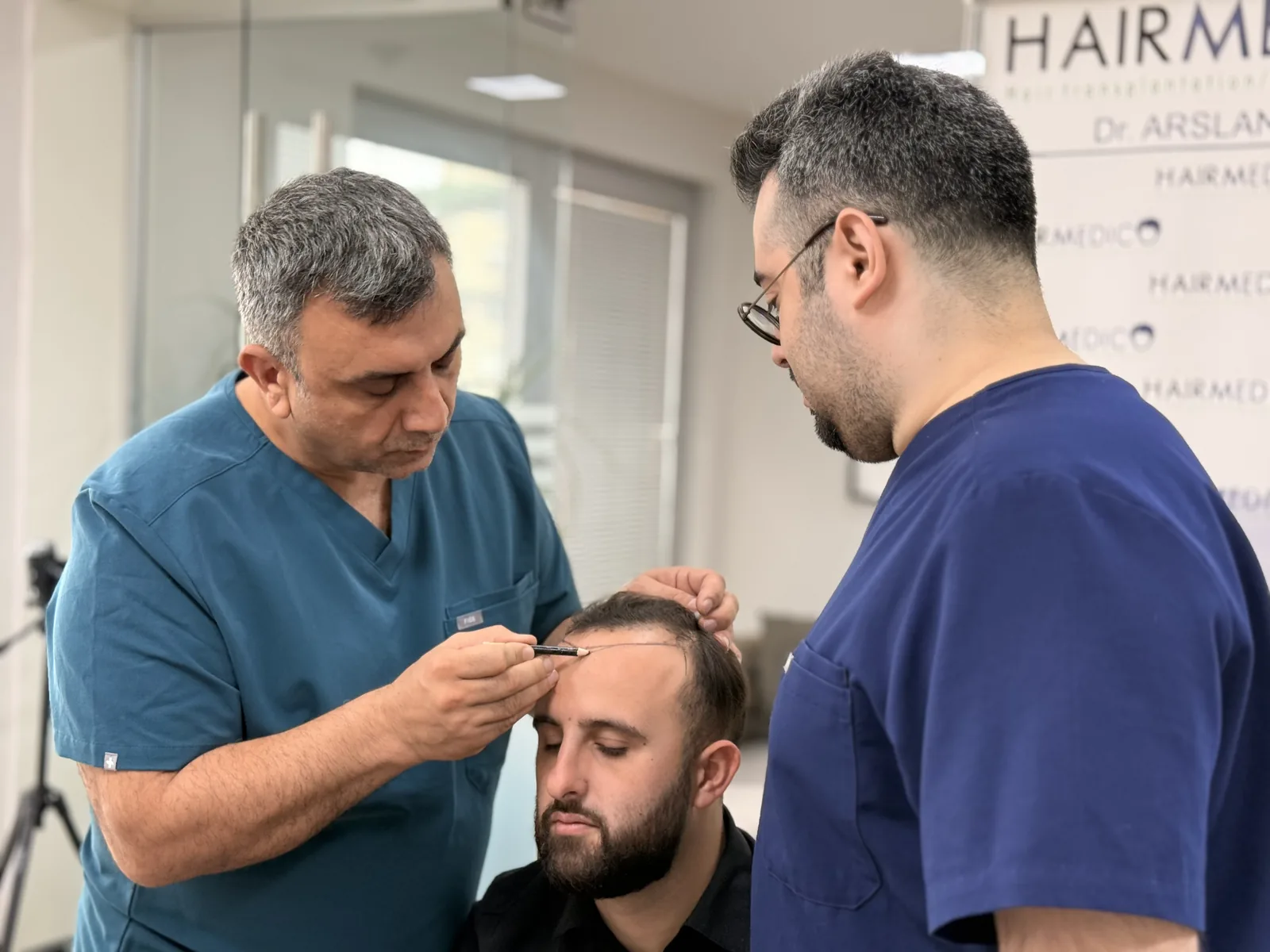
Dr. Arslan Musbeh marking a receding hairline before androgenetic alopecia hair transplant surgery
Dr. Arslan personally maps the new hairline against the existing recession pattern before any incision is made — the same 10–20 year planning horizon applied to every AGA case.

Traction Alopecia

Caused by prolonged mechanical stress on the hairline — tight braiding, extensions, ponytails. Common in women who wore high-tension styles over many years. The follicles in the affected zone are often permanently damaged rather than simply miniaturised. FUE transplant into traction alopecia-affected areas can produce excellent results, provided the underlying cause has been eliminated for at least 12 months before surgery.

Key requirement for traction alopecia: The hairstyling practice that caused the damage must be discontinued before surgery. Transplanting into a zone still under traction stress will fail. Dr. Arslan will confirm this as part of the pre-operative assessment.

Alopecia Areata

An autoimmune condition causing patchy, unpredictable hair loss. Unlike AGA, alopecia areata involves an immune attack on hair follicles — meaning transplanted follicles can potentially also be attacked after surgery. Hair transplant for active alopecia areata is generally not recommended. For patients with longstanding, stable alopecia areata (typically no new patches for 3–5 years), surgery may be considered — but only after thorough evaluation of disease activity and realistic discussion of the risk of recurrence.

The caution around timing exists because surgical trauma to the scalp can itself act as a trigger for autoimmune conditions, potentially provoking a new patch in a zone that was previously quiet — even after a long stable interval. This is why the stability period is judged on documented history rather than current appearance alone, and why Dr. Arslan asks patients with alopecia areata to coordinate with their treating dermatologist before any surgical decision is made.

Scarring Alopecias (Cicatricial)

Conditions such as frontal fibrosing alopecia (FFA), lichen planopilaris, and folliculitis decalvans cause permanent follicle destruction through inflammation. Surgery into actively scarred tissue requires extreme caution — transplanted follicles can fail due to poor vascularisation, and active disease may destroy new grafts. Surgery is only appropriate once the condition is confirmed inactive, and the recipient zone's vascularity must be assessed.

Inflammation in FFA and lichen planopilaris can be patchy, and a zone that looks quiet can still be active under the surface. For this reason, confirmation of disease inactivity comes from the patient's treating dermatologist rather than a visual check at consultation, and each affected area is assessed on its own rather than assuming uniform vascularity across the whole scalp.

Who Is a Candidate?

Surgical candidacy for alopecia patients depends on: type and activity of the alopecia, stability of the condition (confirmed inactive for minimum 12 months), adequacy of donor zone, and realistic expectations. A personal assessment with Dr. Arslan — including detailed photographic review of the affected zones — is essential before any recommendation can be made. See our packages page →

When Surgery Should Wait or Be Avoided

Surgery is not appropriate for: active alopecia areata with recent or ongoing patches; active scarring alopecias (FFA, lichen planopilaris, folliculitis decalvans) not yet confirmed inactive by a dermatologist; traction alopecia where the causative hairstyling practice has not been discontinued; and cases where the donor zone lacks the density to supply the recipient area without thinning the back and sides. In each of these situations, the underlying condition needs to be addressed before hair transplant surgery is even discussed — surgery on top of active disease will not hold.


A "not yet" is not a "no": If your case involves active autoimmune or inflammatory activity, Dr. Arslan may ask you to return for reassessment after a defined interval, or request written confirmation from your treating dermatologist, before scheduling surgery. This is standard clinical practice, not a rejection of your case.
Traction alopecia hairline restoration — FUE hair transplant female patient Hairmedico
Dr. Arslan Musbeh alopecia specialist hair transplant Istanbul FUE Europe member
Hair loss and alopecia specialist at Hairmedico Istanbul — FUE Europe member Dr. Arslan Musbeh.

Frequently asked questions

Answered by Dr. Arslan Musbeh.

Can alopecia patients have hair transplants?

It depends on the type. Androgenetic alopecia and traction alopecia are treatable with transplant. Alopecia areata requires stability before surgery. Dr. Arslan Musbeh assesses each case.

Is hair transplant permanent for alopecia patients?

Transplanted follicles from the permanent donor zone are resistant to the hormonal causes of androgenetic alopecia and will not be lost again.

Can hair transplant surgery trigger a new alopecia areata flare?

It's a recognised risk with autoimmune hair loss. Surgical trauma can act as a trigger in a scalp zone that was previously quiet, which is why Hairmedico requires a documented stability period (typically no new patches for 3–5 years) before considering surgery, and why active alopecia areata is not treated with transplant.

Does a hair transplant cure the alopecia itself?

No. Transplant surgery relocates permanent donor follicles into areas of hair loss — it does not treat the autoimmune activity behind alopecia areata, the inflammation behind scarring alopecias, or the hormonal process behind androgenetic alopecia. Most AGA patients combine surgery with ongoing medical therapy to protect the native hair they still have. Alopecia areata and scarring alopecias need separate dermatological management alongside, or instead of, surgery.

Explore Further

Related resources.

Personal Assessment

Start with
three photographs.

Dr. Arslan reviews every submission personally — technique, candidacy and all-inclusive quote within 24 hours.

Submit Photos — FreeWhatsApp
FUE Europe member surgeon. One patient per day. 17+ years.
Reviews
3,000+
Cases
17+
Years
Verified Patient Reviews

4.8★ Trustpilot — In their own words.

After researching countless clinics, I specifically didn't want a "hair mill." Dr. Arslan is hands-on throughout the entire process. I came from Australia and the experience was seamless.

Dr. Arslan was present throughout the surgery and personally performed the majority of key procedures. His professionalism and dedication made all the difference.

I already see good hair growth after only 17 weeks. The professionalism of the team and facilities was excellent.

Dr. Arslan was incredibly professional — he explained all procedures clearly. The clinic was spotless and the staff were super friendly.

From first contact, communication was prompt, transparent and efficient. My expectations were surpassed by the services and attention I received.

After 5 years of research I chose Hairmedico. Even on a basic package, Dr. Arslan performed the critical incision phase himself.