
Overview
Hair
Transplant
Turkey

Surgeon-led hair restoration clinic in Levent, Istanbul since 2005.

Explore all →
Lorew Paris
Premium hair care by Hairmedico
Discover →
Confidential · Free
Bespoke Assessment by Dr. Arslan

Send 3–5 photographs. Personal response within 24 hours — no intermediaries.

Request Now →
17+
Years
1
Patient/day
Surgery
Techniques
& Procedures

Selected for your specific hair loss pattern and aesthetic goals.

FUE vs DHI →
Interactive Tool
Which Technique Is Right for You?

FUE, DHI or Algorithmic FUE™ — Dr. Arslan recommends based on your photographs and Norwood stage.

Get Assessment →
Try Graft Calculator →
Why Turkey
World-class
surgery.
Local price.

FUE Europe member. Ministry of Health accredited clinic. Levent, Istanbul — 60–80% less than UK or US.

View Package →
The Surgeon
Dr. Arslan
Musbeh

FUE Europe member. Ministry of Health accredited. 17+ years. 3,000+ personal procedures. One patient per day.

Full Profile →
Dr. Arslan · Istanbul
"One patient. One day. No exceptions."

One patient a day, every package surgeon-led. Every result personally accountable.

Read Philosophy →
17+
Years
3,000+
Cases
FUE
Europe
Pricing
All-Inclusive
Packages

No hidden costs. Hotel, transfers, surgery and aftercare in one price.

View Pricing →
Most Chosen
VIP

Silver · Gold · VIP — 5-star hotel · Airport transfers · PRP included

View Pricing →
Graft Calculator →
Results
Real
Before
& After

Every case personally overseen by Dr. Arslan Musbeh, from consultation to results.

Full Gallery →
Non-Surgical
Beyond
Surgery

Not every case needs a transplant. Medical treatments, therapies and specialist options.

Overview →
Medical Education
Learn
before
you decide.

Guides, tools and expert content — written by Dr. Arslan Musbeh.

All Articles →
Bespoke Assessment WhatsApp
Hair Transplant
Hair Transplant Turkey
Techniques
Techniques
Procedures
Why Turkey
Country Comparisons
Non-Surgical
Medical Treatments
Learn
Guides & Tools
Clinic Dr. Arslan Musbeh Pricing & Packages Before & After About Hairmedico Contact
FUE Europe Member
1 Patient / Day
250+ Physicians Trained
Hairmedico›Hair Transplant›Menopause Hair Loss
Menopause Hair Loss Guide

Menopause & Hair Loss —
Causes, Treatment & Surgery.

Oestrogen decline during menopause is a leading cause of hair loss in women over 45, producing diffuse Ludwig-scale thinning rather than a receding hairline. This clinical guide covers why it happens, which treatments work, and when transplant surgery is the right path.

45+
Age when oestrogen decline typically becomes a leading cause of hair loss in women
2–5%
FDA-approved topical minoxidil concentration for female pattern hair loss
Ludwig-Scale
Diffuse thinning pattern — frontal hairline usually preserved
Menopause hair loss women — hormonal thinning treatment options Hairmedico Istanbul

Why Menopause Causes Hair Loss

Oestrogen and progesterone help maintain the hair growth cycle — extending the anagen (growth) phase and suppressing the effects of androgens on scalp follicles. As oestrogen levels decline during perimenopause and menopause, this protective effect is reduced. The result is an increase in follicle sensitivity to DHT, leading to a pattern of diffuse thinning across the crown and midpart that may accelerate significantly in the years around menopause.

This is distinct from male-pattern baldness — female menopausal hair loss rarely produces the defined receding hairline seen in men, and the frontal hairline is usually preserved. The pattern is typically Ludwig-scale diffuse thinning.

Perimenopause, Menopause or Something Else?

Hair loss in the 40s and 50s is not always menopause acting alone, and telling the causes apart changes what treatment makes sense. Oestrogen decline typically becomes a driving factor for diffuse thinning around this age, but it frequently overlaps with other conditions that produce a similar picture on the scalp — see our full guide to hair loss causes in women for the complete picture. The most common overlaps Dr. Arslan checks for are:

  • Perimenopause vs established menopause: During perimenopause, oestrogen fluctuates rather than falling steadily, so shedding can be intermittent and harder to pin down. Once menopause is established and oestrogen settles at a lower baseline, thinning tends to become steadier — which is also when it becomes easier to judge whether it has stabilised enough for surgery to be considered.
  • Thyroid dysfunction: Both an underactive and an overactive thyroid can cause diffuse shedding that looks identical to hormonal hair loss on the scalp. A TSH test is one of the first checks requested before attributing loss to menopause alone.
  • Iron deficiency anaemia: Low ferritin is a common, reversible contributor to diffuse thinning in women over 40, and frequently compounds menopausal loss rather than replacing it.
  • Telogen effluvium: A temporary, stress- or illness-triggered shedding phase that can coincide with menopause but usually resolves within months rather than progressing indefinitely.

Because these causes can overlap, the blood panel described below — not an assumption based on age alone — is what separates a targeted treatment plan from guesswork.
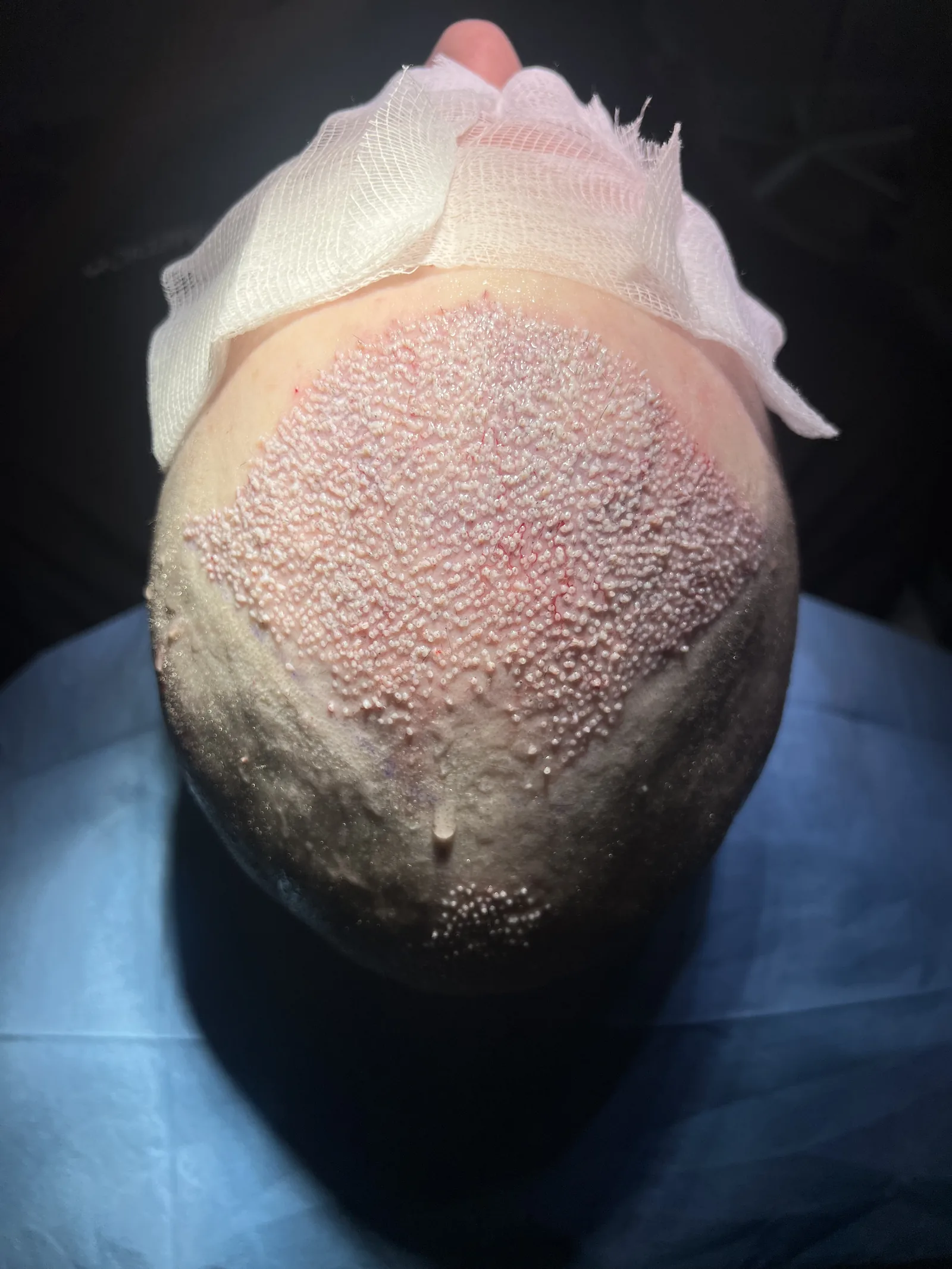
Donor area at the back of the scalp shortly after FUE extraction, showing even follicle spacing
The donor area shortly after FUE extraction — donor density here is exactly what Dr. Arslan evaluates before confirming candidacy, in menopausal thinning as in any other pattern.

Hormonal and Non-Hormonal Treatments

Before surgical options are considered, non-surgical treatments should be evaluated — many women achieve meaningful stabilisation and some improvement with appropriate medical management.

  • Hormone Replacement Therapy (HRT): May slow or reverse hair loss in women whose loss is directly driven by oestrogen decline. The decision to use HRT involves broader health considerations and requires a gynaecologist or endocrinologist's assessment.
  • Topical minoxidil (2–5%): The most evidence-supported topical treatment for female pattern hair loss. FDA-approved. Used daily, it can maintain density and produce modest regrowth. Cessation reverses any benefit.
  • Oral spironolactone (low-dose): An anti-androgen used off-label in women. Reduces DHT effects. Requires prescription and monitoring.
  • PRP therapy: Multiple sessions of scalp injections can support density maintenance. Moderate evidence; useful as an adjunct.
  • Nutritional support: Iron deficiency is frequently associated with diffuse hair loss in women. A full panel including ferritin, thyroid function (TSH) and vitamins should be checked before any treatment is initiated.
Before any treatment: Dr. Arslan always recommends a blood panel ruling out thyroid dysfunction, iron deficiency anaemia, and hormonal imbalance as primary causes. Treating the underlying cause — if present — can produce significant improvement without surgical intervention.

When Is Hair Transplant Appropriate After Menopause?

Hair transplant surgery can be appropriate for women with menopause-related hair loss under specific conditions. These include: loss that has stabilised on medical management, adequate donor density at the back and sides, specific pattern of loss (hairline recession, traction zones, defined bald areas rather than diffuse thinning), and realistic expectations.

Diffuse thinning across the entire scalp — without a clear stable pattern — is challenging to treat surgically because the donor zone may also be affected. Dr. Arslan assesses each case individually. Women with established, stable traction alopecia or hairline recession following menopause can be excellent candidates for FUE or DHI surgery.

When surgery is the right path, DHI (Choi pen) implantation is generally the preferred technique for menopausal hair loss, as it is for female pattern hair loss generally — grafts are placed between existing hairs without shaving the recipient area, so the procedure stays discreet while it grows in. Graft numbers follow the Ludwig stage and donor capacity rather than a fixed figure: earlier, Ludwig I presentations typically need in the range of 1,000–1,800 grafts, Ludwig II around 1,500–2,500, and more advanced but still stable Ludwig III cases 2,000–3,500 grafts across one to two sessions. The graft calculator gives a starting estimate, but Dr. Arslan confirms the actual number only after examining donor density and loss pattern directly.

The Assessment Process for Women

The assessment protocol for female patients differs from male AGA cases. Dr. Arslan's review includes: photographic analysis of the loss pattern, evaluation of donor zone density and quality, discussion of medical and hormonal history, and a frank conversation about surgical vs non-surgical paths.

Good candidates for surgery

  • Hair loss that has stabilised for at least 6–12 months on medical management, rather than actively progressing
  • A defined pattern — hairline recession, traction alopecia, or a clearly bordered thinning zone — rather than uniform diffuse loss across the whole scalp
  • Adequate donor density at the back and sides, confirmed by direct examination rather than assumed from age or scalp appearance
  • Underlying causes such as thyroid dysfunction, iron deficiency or hormonal imbalance already investigated and, where present, treated

Better served by medical management first

  • Hair loss that is still actively progressing — grafts placed into an unstable pattern can end up sitting alongside native hair that keeps thinning
  • Diffuse thinning that also affects the donor zone, where there may not be enough stable density to harvest from safely
  • Untreated thyroid dysfunction, iron deficiency or other blood-panel findings that have not yet been addressed
  • Women still deciding on HRT, where hair loss may partially stabilise or improve once the hormonal treatment plan is settled

See our packages and pricing → for more information.

Women hair transplant FUE technique female patient Hairmedico Istanbul thinning hairline
Dr. Arslan Musbeh women hair transplant specialist Istanbul — menopause hair loss treatment
Hair loss and alopecia specialist at Hairmedico Istanbul — FUE Europe member Dr. Arslan Musbeh.

Frequently asked questions

Answered by Dr. Arslan Musbeh.

Does menopause cause hair loss?

Yes. The drop in oestrogen during menopause can trigger or accelerate female pattern hair loss. Hair becomes finer, the parting widens, and overall density decreases.

Can menopausal hair loss be treated with transplant?

Surgery is considered when hair loss is stable and donor density is adequate. Dr. Arslan Musbeh evaluates medical history and current loss pattern before recommending transplant.

Does hair loss from menopause eventually stop?

Not fully on its own. Thinning is often most active while oestrogen is still declining, and tends to steady once menopause is established — but it rarely returns to prior density without treatment. Hormone replacement therapy or topical minoxidil are the options shown to slow the loss or produce modest improvement; without them, the thinning that has already occurred generally persists.

Do I need to shave my head for a hair transplant after menopause?

Usually not. DHI (Choi pen) implantation allows grafts to be placed between your existing hairs, so the recipient area does not need to be shaved and the results stay discreet while they grow in. Dr. Arslan confirms which technique suits your specific pattern during assessment.

How many grafts are typically needed for menopause-related hair loss?

It depends on the Ludwig stage and donor capacity rather than a fixed number. As a general range, earlier Ludwig I thinning typically needs around 1,000–1,800 grafts, Ludwig II around 1,500–2,500, and more advanced but still stable Ludwig III cases 2,000–3,500 grafts across one to two sessions. The exact number is set only after Dr. Arslan examines your donor density directly.

Explore Further

Related resources.

Personal Assessment

Start with
three photographs.

Dr. Arslan reviews every submission personally — technique, candidacy and all-inclusive quote within 24 hours.

Submit Photos — FreeWhatsApp
FUE Europe member surgeon. One patient per day. 17+ years.
Reviews
3,000+
Cases
17+
Years
Verified Patient Reviews

4.8★ Trustpilot — In their own words.

After researching countless clinics, I specifically didn't want a "hair mill." Dr. Arslan is hands-on throughout the entire process. I came from Australia and the experience was seamless.

Dr. Arslan was present throughout the surgery and personally performed the majority of key procedures. His professionalism and dedication made all the difference.

I already see good hair growth after only 17 weeks. The professionalism of the team and facilities was excellent.

Dr. Arslan was incredibly professional — he explained all procedures clearly. The clinic was spotless and the staff were super friendly.

From first contact, communication was prompt, transparent and efficient. My expectations were surpassed by the services and attention I received.

After 5 years of research I chose Hairmedico. Even on a basic package, Dr. Arslan performed the critical incision phase himself.