Why Surgeon-Led Hair Transplants
Deliver Better Results
Why surgeon-led hair transplant procedures produce better outcomes than technician-run clinics: the clinical evidence and the quality.
Reviewed by Dr. Arslan Musbeh · Last updated 2026-04-18
Why surgeon-led hair transplant procedures produce better outcomes than technician-run clinics: the clinical evidence and the quality mechanisms.
The clinical mechanisms — why it matters who operates
The most consequential decision in hair transplant surgery is not the technique used or the clinic location — it is who performs the surgery. Surgeon-led procedures outperform technician-run procedures across every measurable dimension:
Transection rate
Follicular transection — cutting through the follicle during extraction — permanently destroys the graft. Experienced surgeons achieve 2–5% transection rates. Undertrained technicians consistently exceed 10–20%. In a 3,000-graft session: the difference between 3% and 15% transection is 360 permanently destroyed grafts that will never grow.
Channel creation quality
Channel angle, direction and density determine the naturalness of the final result. This requires aesthetic judgement and anatomical training that cannot be taught to non-physicians in the same way mechanical extraction can.
Hairline design
Natural hairline design requires understanding of facial proportions, ethnic anatomy, ageing trajectories and long-term planning. It is a medical and aesthetic judgement call that cannot be delegated.
Complication recognition
A trained surgeon recognises complications during the procedure and adapts technique in real time. Technicians cannot. This makes the surgery both more consistent and more safe.
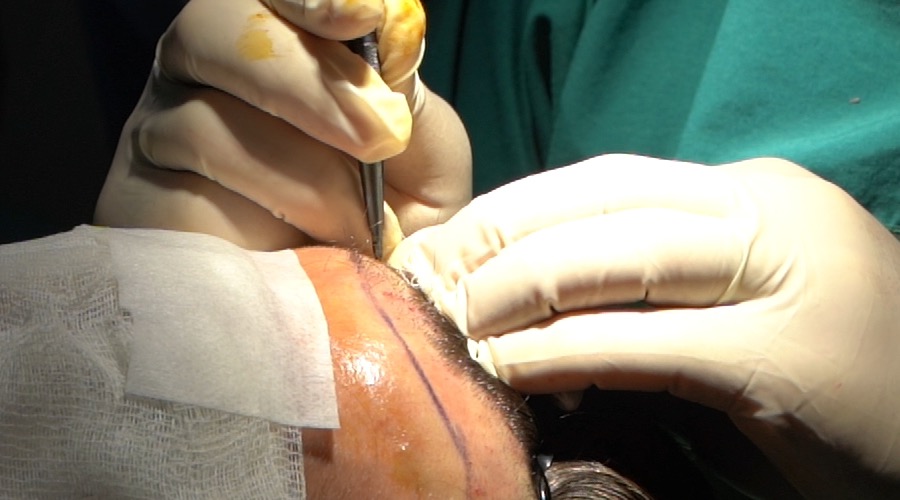
Hairmedico — the surgeon-led standard in practice
At Hairmedico, Dr. Arslan Musbeh is the only person who extracts follicles and creates channels. No exceptions. He also personally places every graft in the VIP tier; in Silver and Gold, his trained team places grafts under his direct, in-room supervision. The one-patient-per-day protocol ensures no time pressure causing delegation. This is verifiable in every patient review that specifically mentions Dr. Arslan's continuous presence throughout the surgical day — consistent across verified Trustpilot reviews.

Common questions
How much does a hair transplant cost in Turkey?
Hairmedico all-inclusive: price on request for 2,000–3,500 grafts including surgery, 5-star hotel, transfers, PRP and 12-month follow-up.
Is hair transplant permanent?
Yes. Transplanted follicles are DHT-resistant and grow permanently for the patient's lifetime.
What is the recovery time?
Desk work: 5–7 days. Scabs shed by Day 10–14. New growth from months 3–5. Final result months 12–14.
Who performs surgery at Hairmedico?
Dr. Arslan Musbeh personally performs every extraction and canal-opening. In VIP he also places every graft himself; in Silver and Gold, his trained team places the grafts under his direct supervision. One patient per day.
Is Turkey safe for hair transplant?
Yes, with an accredited surgeon-led clinic. Verify FUE Europe membership, Ministry of Health registration, and confirm the surgeon personally operates.
References & sources
- International Society of Hair Restoration Surgery. Practice census — global hair restoration statistics.. 2022. fue-europe.com
- Onda M et al. Follicular unit extraction: a systematic review. J Plastic & Aesthetic Surgery. 2020. doi.org
- NHS. Hair loss — overview. National Health Service UK. 2023. nhs.uk
- MedlinePlus NIH. Hair transplantation — clinical overview. U.S. National Library of Medicine. 2024. medlineplus.gov
- Bernstein RM. Follicular unit transplantation. Dermatologic Clinics. 2013. doi.org
All references are peer-reviewed medical literature or official health authority publications. No commercial sources included.
Send three photographs.
Front hairline, crown and both sides. Dr. Arslan Musbeh reviews every submission personally and replies within 24 hours with a Norwood assessment, a technique recommendation and a graft estimate. Free, no obligation.
Request a Bespoke Assessment