Robotic Hair Transplant 2025 —
Myths vs Clinical Reality
Robotic hair transplant systems in 2025: what they actually do, their limitations, why Hairmedico uses surgeon-led FUE over robotic.
Reviewed by Dr. Arslan Musbeh · Last updated 2026-04-17
Robotic hair transplant systems in 2025: what they actually do, their limitations, why Hairmedico uses surgeon-led FUE over robotic systems, and when
What Robotic Systems Actually Do
Robotic systems like ARTAS assist in two phases: donor area mapping (digital trichoscopy) and extraction (robotic punch tool). The robot identifies follicular units via camera imaging and guides a punch device to extract them in a pre-programmed pattern. They do not design hairlines, create recipient channels or implant grafts — these remain manual surgical steps in all current systems.
Clinical Limitations of Robotic Systems
1. Hair type limitations: Current robotic systems perform best on straight, dark hair against light skin. Curly, fine, grey or very blonde hair — and all Afro-textured hair — present tracking challenges that increase transection rates.
2. Speed: Experienced manual FUE surgeons typically extract grafts faster than current robotic systems for sessions above 2,000 grafts.
3. Adaptability: A surgeon can micro-adapt extraction angle mid-procedure based on feel and tissue response. Current robotic systems cannot replicate this tactile intelligence.
4. Cost: ARTAS equipment costs add significant overhead — passed to the patient without proportional outcome improvement in most standard cases.
When Robotics Add Value
Robotic-assisted donor mapping (trichoscopy + AI distribution planning) is genuinely useful for complex cases. At Hairmedico, digital planning tools are used for every case — capturing the analytical benefit of robotic planning without the limitations of robotic extraction.

Why Hairmedico Is Surgeon-Led, Not Robot-Led
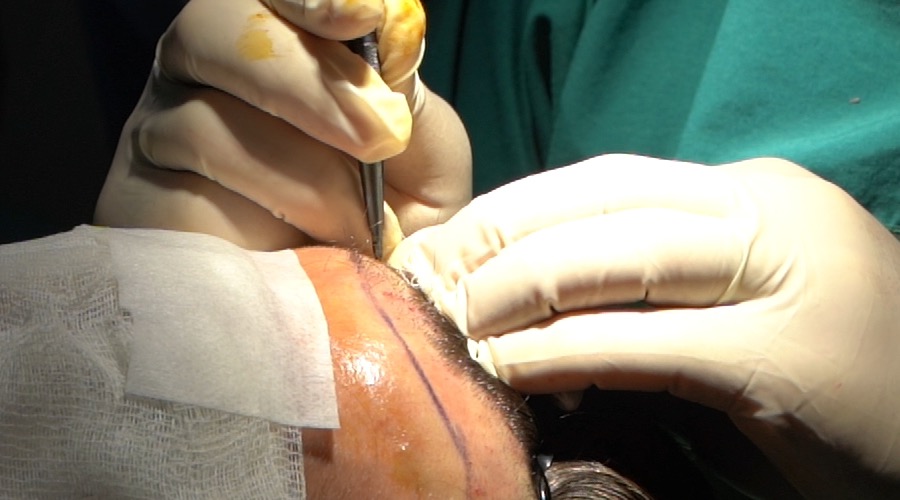
The most important variable in hair transplant outcomes is not the extraction device — it is the surgeon's hairline design, channel creation and strategic planning. A beautifully extracted graft placed in a channel at the wrong angle produces a bad result. A slightly imperfect extraction placed in a perfect channel produces a natural result. Dr. Arslan personally performs all critical surgical phases for every patient. → Hair Transplant | Dr. Arslan Musbeh | Pricing

Common questions
What is DHI hair transplant?
DHI (Direct Hair Implantation) uses a Choi implanter pen that creates a recipient channel and places the graft simultaneously in one motion. Unlike FUE where channels are pre-created, DHI combines these steps, offering superior angle control and enabling placement between existing hairs without shaving.
Who is the best candidate for DHI hair transplant?
DHI is best for: patients with existing hair in the recipient zone (thinning rather than fully bald), women with diffuse thinning, patients who cannot shave (unshaved DHI), and anyone requiring very high-precision hairline density work.
Is DHI hair transplant painful?
No. DHI is performed under local anaesthesia — the scalp is fully numb throughout. At Hairmedico, the Comfort-in needle-free injector eliminates the needle sting of anaesthetic administration, making the entire procedure pain-free.
How long does DHI take?
DHI takes longer per graft than standard FUE because each graft is loaded individually into the Choi pen. A 2,000-graft DHI session typically takes 7–9 hours. Dr. Arslan performs the entire procedure personally.
References & sources
- Onda M et al. Follicular unit extraction: A systematic review of the literature. Journal of Plastic, Reconstructive & Aesthetic Surgery. 2020. https://doi.org/10.1016/j.bjps.2019.11.006
- Bernstein RM, Rassman WR. Follicular unit transplantation: 2005. Dermatologic Clinics. 2005. https://doi.org/10.1016/j.det.2005.01.007
- Avram MR, Rogers NE. Contemporary hair transplantation. Dermatologic Surgery. 2009. https://doi.org/10.1111/j.1524-4725.2009.01338.x
- American Academy of Dermatology Association. Hair loss: diagnosis, treatment and outcome. AAD Guidelines. 2023. https://www.aad.org/public/diseases/hair-loss/treatment
- International Society of Hair Restoration Surgery. Practice census survey — global hair restoration statistics. 2022. https://www.fue-europe.com/professionals/resources/practice-census/
- NHS. Hair loss — overview and treatment options. National Health Service (UK). 2023. https://www.nhs.uk/conditions/hair-loss/
All references are peer-reviewed medical literature or official health authority publications. No commercial sources included.
Send three photographs.
Front hairline, crown and both sides. Dr. Arslan Musbeh reviews every submission personally and replies within 24 hours with a Norwood assessment, a technique recommendation and a graft estimate. Free, no obligation.
Request a Bespoke Assessment