Minoxidil vs hair transplant: cost, results, permanence and who should choose which.
How each treatment works
Understanding the mechanism of each treatment is essential to evaluating them honestly.

Minoxidil
Minoxidil is a topical vasodilator originally developed as an oral hypertension medication. Its hair-growing effect was discovered as a side effect in the 1980s. Applied to the scalp, it prolongs the anagen (active growth) phase of the hair cycle and increases follicular size and blood supply. It does not block DHT — the hormone responsible for androgenetic alopecia — and therefore does not address the underlying cause of pattern hair loss.
Available in 2% and 5% topical solutions and foam, and increasingly as oral low-dose minoxidil (0.25–2.5mg daily). Results depend on the stage of loss and individual response.
Hair transplant (FUE)
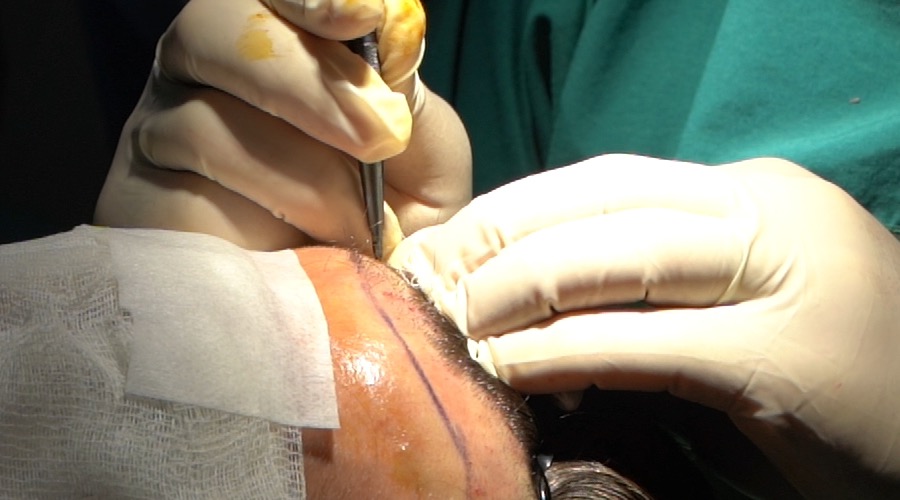
FUE (Follicular Unit Extraction) physically relocates genetically DHT-resistant follicles from the permanent donor zone to thinning or bald areas. The transplanted follicles retain their resistance to DHT in their new location. Hair grows permanently — it does not require ongoing treatment to maintain.
Results: what to expect from each
| Minoxidil | FUE Hair Transplant | |
|---|---|---|
| Response rate | ~50% of users see meaningful improvement | 95%+ graft survival in experienced hands |
| Results appear | 3–6 months of consistent use | 12–14 months post-procedure |
| Permanence | Temporary — loss resumes within months of stopping | Permanent — transplanted hair does not fall out |
| Area treated | Diffuse — applied across entire scalp | Targeted — specific areas are restored |
| Baldness reversal | Cannot restore hair to follicles already dead | Restores density to bald areas |
| Daily commitment | Twice daily, indefinitely | One procedure — no ongoing application |
Minoxidil is a maintenance tool. It slows the process and can improve the calibre of existing hairs. But once a follicle is lost, no topical can bring it back. That is the fundamental limitation — and the reason surgery remains the only permanent solution. — Dr. Arslan Musbeh
Cost comparison over 10 years
A frequently overlooked factor is the cumulative cost of medical treatment.
| Treatment | Annual cost | 10-year cost | Result |
|---|---|---|---|
| Minoxidil 5% (topical) | £180–£360 | £1,800–£3,600 | Temporary, requires continuation |
| Finasteride (generic) | £120–£240 | £1,200–£2,400 | Temporary, requires continuation |
| Minoxidil + Finasteride | £300–£600 | £3,000–£6,000 | Temporary, requires continuation |
| FUE Istanbul (all-inclusive) | — | from €2,600 (one payment) | Permanent |
For patients who have used minoxidil for several years without significant improvement, the cost of continuing treatment indefinitely often exceeds the one-time cost of a hair transplant within 5–10 years — with inferior and impermanent results.
Who should use minoxidil? Who needs a transplant?
Minoxidil is the right first step if:
- You have early-stage loss (Norwood I–II) with active progression
- You are under 25 and loss is not yet stabilised
- You want to slow loss while evaluating your options
- You have diffuse thinning without significant bald areas
- You want to improve the quality of existing thin hair
Hair transplant is the appropriate treatment if:
- You have areas that are significantly thinned or bald (Norwood III+)
- Medical treatment has plateaued or you have stopped responding to minoxidil
- You want a permanent solution that does not require daily commitment
- Your hair loss is stabilised (or medically managed)
- You have adequate donor zone density
The combination approach
Many patients benefit from both: medical treatment (minoxidil ± finasteride) to preserve native hair and prevent further loss, combined with surgery to restore areas already lost. At Hairmedico, all surgical packages include 12 months of follow-up during which post-operative medical management is supervised.
The honest summary
Minoxidil is a good tool for early-stage prevention and maintenance. It is not a restoration treatment. For patients with meaningful bald areas, ongoing medical treatment delays the inevitable while accumulating cost — surgery addresses the problem directly and permanently.
The right answer depends on your specific stage, age and goals. A free consultation with Dr. Arslan Musbeh — including a personal graft estimate — will give you a clinical recommendation specific to your case.
Request a free assessment → — Send 3 photographs. Response within 24 hours.