The 10 most common hair transplant myths — from 'it looks fake' to 'Turkey isn't safe' — debunked with clinical evidence by Dr.
The 10 most common hair transplant myths
Myth 1: "Hair transplants look fake and obvious"
Reality: This was true of the "hair plug" era of the 1980s and 90s, when large multi-follicular grafts were transplanted in visible rows. Modern FUE transplants use individual follicular units of 1–4 hairs — the same groupings that occur naturally in your scalp. When performed by a skilled surgeon who matches angle, direction and density to your native hair, the result is undetectable.
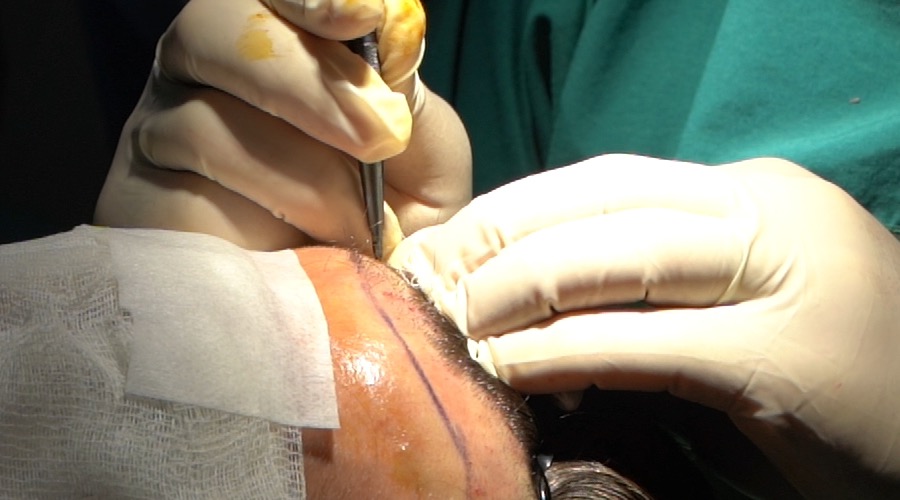
The cases where results look artificial are typically the result of: a poorly designed hairline (too low, too straight or too dense at the front), incorrect angle or direction during implantation, or overuse of single-hair grafts creating an unnatural "feathered" effect. Surgeon skill — not the technique itself — determines naturalness.
Myth 2: "Transplanted hair falls out after a few years"
Reality: Transplanted follicles are taken from the permanent donor zone at the back and sides of the scalp — areas genetically resistant to DHT, the hormone that causes androgenetic alopecia. These follicles retain their DHT resistance in their new location. They will not fall out from pattern baldness.
What patients sometimes observe is: initial shedding at 2–4 weeks (normal "shock loss" — the follicle is intact, not lost), and the fact that their non-transplanted native hair continues to thin over time. A well-planned procedure accounts for this future progression in the hairline design.
Myth 3: "Hair transplants in Turkey are lower quality"
Reality: The quality of a hair transplant depends on the surgeon's training, experience and methodology — not the country where it is performed. The Istanbul clinics that attract international patients at premium all-inclusive prices operate to the same surgical standards as leading clinics in the UK, USA or Germany.
The price difference (60–80% lower) exists because of operating costs, not surgical quality. The distinction to make is between surgeon-led clinics — where the named doctor performs every graft — and "hair mills" where technicians operate largely unsupervised. This distinction exists in every country.
Myth 4: "I need to shave my head for a hair transplant"
Reality: Unshaven FUE (U-FUE) allows extraction and transplantation while keeping existing hair length intact. At Hairmedico, this technique is available for patients who cannot or prefer not to shave. The tradeoff is slightly increased procedure time and cost, and a more technically demanding extraction process. Results are equivalent to standard FUE.
Myth 5: "You can get 6,000 grafts in one session safely"
Reality: The maximum safe single-session graft count is a function of your donor density and scalp surface area — not a fixed number. For most patients, 4,000–4,500 grafts is a safe upper limit in a single session without compromising donor zone integrity. Claims of 6,000–8,000 grafts in one session should be approached with serious caution.
Overharvesting — extracting more grafts than the donor zone can safely yield — causes permanent visible thinning of the donor area. This is a result that cannot be reversed. Any clinic offering very high graft counts without a thorough donor assessment is likely prioritising revenue over patient outcomes.
Myth 6: "Results appear immediately"
Reality: The full result of a hair transplant takes 12–14 months to appear. The typical timeline: grafts shed at 2–4 weeks (shock loss — normal), new growth begins at months 3–4, significant density visible at month 6, texture normalises by month 9, and the final result is reached at month 12–14. Patients expecting immediate results will be disappointed regardless of how technically excellent the procedure was.
Myth 7: "Any doctor can perform a hair transplant"
Reality: In many countries — including Turkey — the regulatory requirements for who can perform hair transplants are insufficiently strict. This has enabled the rise of technician-led clinics where non-physicians perform extractions and implantations. A qualified hair transplant surgeon should be a medical doctor with specific training in hair restoration, ideally with professional accreditation from a recognised body such as FUE Europe or ESHRS.
Myth 8: "PRP alone can restore hair"
Reality: PRP (Platelet-Rich Plasma) is a valuable complementary treatment that can slow loss, improve hair calibre and accelerate post-operative recovery. It cannot restore hair to areas where follicles are already dead. PRP works best as a preventative or supportive treatment alongside medical or surgical management — not as a standalone restoration option.
Myth 9: "Hair transplant is only for men"
Reality: Women account for approximately 15–20% of hair restoration patients globally. Female pattern hair loss, traction alopecia, hairline lowering and eyebrow restoration are all well-established indications for hair transplant surgery. The techniques and recovery are similar; the planning differs because female hair loss patterns are diffuse rather than patterned, and donor zone assessment is more complex.
Myth 10: "I can go back to work the next day"
Reality: Recovery timelines vary by procedure type and individual healing. Most patients are comfortable returning to office-based work within 5–7 days. The recipient area is visible (pinpoint scabs) for 10–14 days. Physical exercise should be avoided for 3–4 weeks. Social commitments requiring close scrutiny of the scalp should be planned around a 2-week recovery window.
Read the full post-operative care guide →