Hair Transplant Under 25.
Age alone doesn’t disqualify anyone — but hair loss under 25 is usually still progressing, and transplanted hair is permanent while the hair around it may not be. Dr. Arslan Musbeh reviews each case individually, tracking stability over 12–24 months before recommending surgery.
Age alone does not disqualify anyone, but hair loss under 25 is usually still progressing — and that is what makes early surgery risky. Transplanted hair is permanent; the hair behind it may not be. Operating before the pattern is established can leave transplanted hair standing in front of a bald area later.
Why age matters surgically, not cosmetically
Androgenetic alopecia is progressive. In your early twenties the final pattern is usually not yet visible, so a surgeon is planning against an unknown. Two specific problems follow.
The isolated hairline
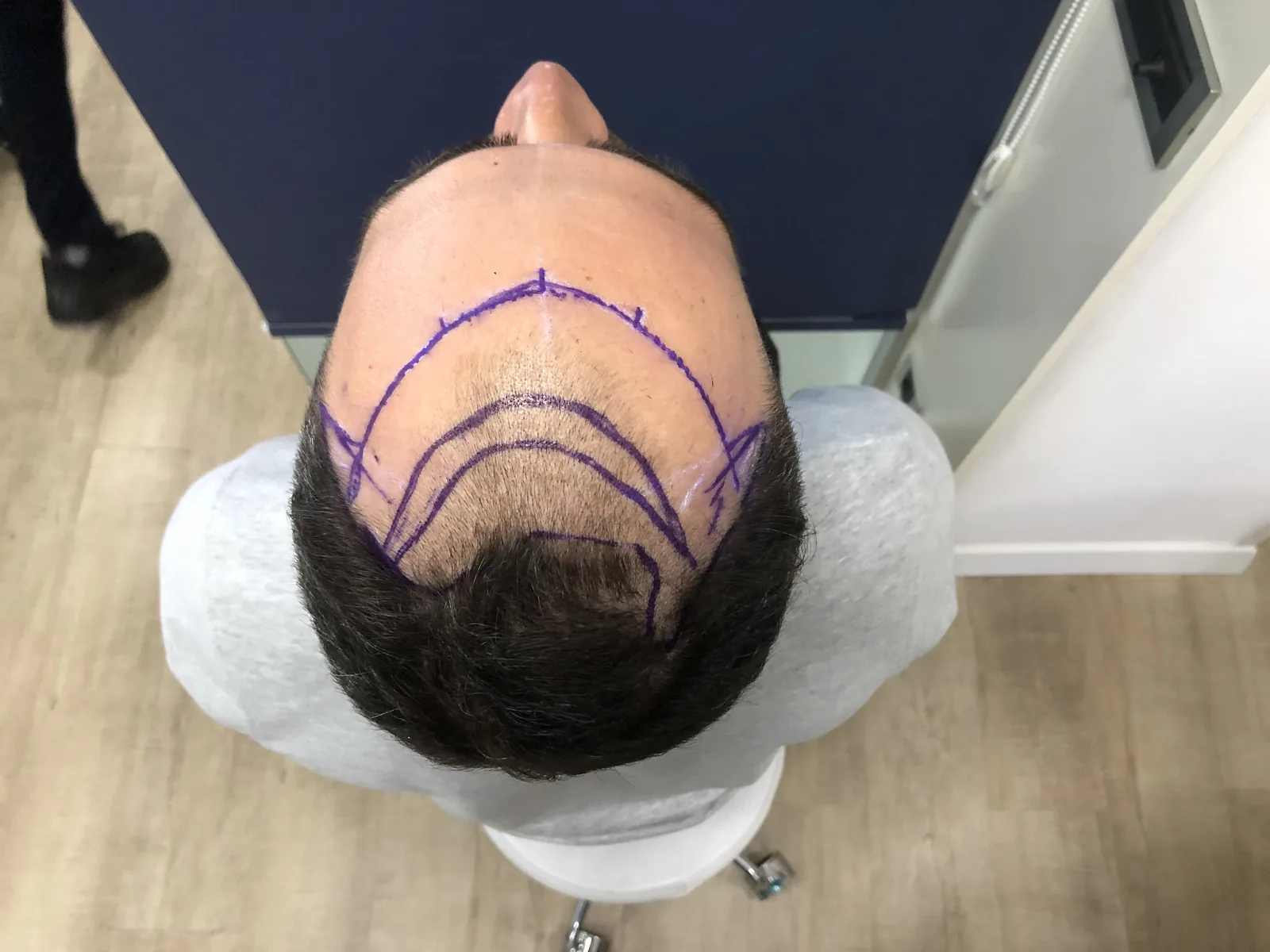
A dense, low hairline placed at 22 looks correct at 22. If loss continues behind it, that hairline can end up as a band of hair with thinning behind — a result that is harder to correct than the original loss.
Donor supply spent early
The donor area is finite and does not regenerate. Grafts used to chase early loss are not available for the more extensive coverage that may be needed at 35 or 45.
The pattern is still being read
The Norwood scale is the reference surgeons use to describe how far a pattern has progressed, but a single reading is a snapshot, not a forecast. A Norwood II at 22 can stay a Norwood II for decades, or reach a Norwood V by 30 — the classification alone does not say which. That is why the same dated photographs used to judge stability are checked against the scale at each review, rather than a stage being assigned once and treated as fixed.

What is usually advised first
| Step | Purpose |
|---|---|
| Establish the rate of loss | Photographs over 12–24 months show whether loss is stable or advancing. |
| Medical treatment | Medication that slows progression is generally considered before surgery. It is prescribed after examination — see medical treatment options. |
| Family pattern | Relatives’ eventual pattern is an imperfect but useful indicator of where yours may end. |
| Donor assessment | Establishes the ceiling on lifetime coverage before any grafts are spent. |
When surgery under 25 can be reasonable
Some cases are straightforward: loss that has been stable for years, a strong donor area, a limited area to cover, and a patient who accepts a conservative hairline designed for the face at 40 rather than at 22. Traction alopecia, scarring and post-injury repair are different situations again — they are not progressive in the same way, and are covered under repair procedures.
In practice these factors are weighed against each other, not applied as a checklist. A rough guide to which way they point:
| Factor | Supports earlier surgery | Supports waiting |
|---|---|---|
| Rate of loss | Stable for at least two years on dated photographs | Still visibly changing month to month |
| Pattern extent | Limited, well-defined area — a temple line or hairline that has settled | Diffuse thinning across the crown or mid-scalp, not yet settled |
| Donor area | Dense donor zone relative to the area needing coverage | Uncertain reserve against a pattern that may still expand |
| Hairline expectations | Accepts a higher, conservative line built for the decades ahead | Wants the lowest, densest line the donor area can support today |
| Underlying cause | Non-progressive — traction alopecia, scarring, a fixed injury | Androgenetic pattern that has not finished evolving |

Dr. Arslan Musbeh assesses each case individually and will say when he thinks waiting is the better option. That is a clinical judgement, not a policy.
Common questions
Can I have a hair transplant at 21 or 22?
There is no legal age limit, but hair loss at that age is usually still progressing. Most surgeons prefer to establish the rate of loss first, because transplanted hair is permanent while the surrounding hair may continue to thin.
What happens if I have a transplant too early?
Two things can go wrong. Loss continues behind a transplanted hairline, leaving hair in front of a thinning area; and donor grafts spent early are unavailable for the larger coverage that may be needed later.
Should I take medication before considering surgery?
Medical treatment that slows progression is generally considered first at a young age. It is prescribed after examination, not bought online, and it does not suit everyone.
How long should I wait?
Long enough to show whether the loss is stable, usually assessed over 12 to 24 months with dated photographs. Stability matters more than a specific birthday.
Is a conservative hairline really necessary?
A hairline is designed for the face you will have at 40 and 60, not only at 22. A low, dense line placed early is the most common regret in patients who had surgery young.
Will starting Finasteride or Minoxidil now rule out a transplant later?
No. Medical treatment and a future transplant are not mutually exclusive — Finasteride and Minoxidil slow the loss of the hair you still have; they do not affect grafts if surgery follows later. Many patients continue medication after surgery specifically to protect the native hair around the transplanted area. See Finasteride & Minoxidil for the full comparison.
Does Hairmedico ever operate on patients in their early twenties?
Yes, when the case supports it. A stable pattern, a non-progressive cause such as traction alopecia or a fixed injury, or a well-defined area like a temple line that has settled can make surgery reasonable well before 25. The decision follows a review of dated photographs, not a fixed age rule.
Send three photographs.
Front hairline, crown and both sides. Dr. Arslan Musbeh reviews every submission personally and replies within 24 hours with a Norwood assessment, a technique recommendation and a graft estimate. Free, no obligation.
Request a Bespoke Assessment