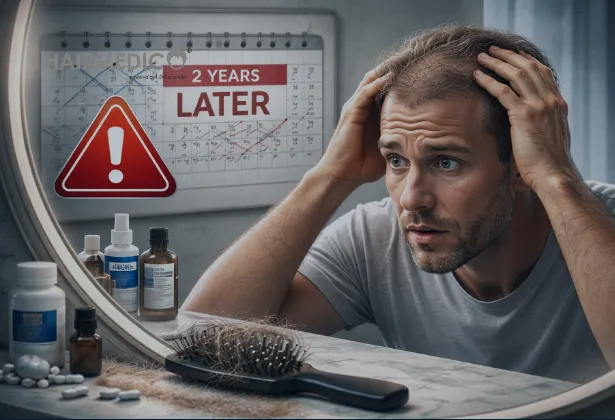
Hair transplantation is often marketed as a definitive, life-changing solution to hair loss. In the first months, results can look impressive: new hair growth, improved appearance, renewed confidence. Yet in clinical reality, a significant number of patients return after two years expressing disappointment, frustration, or even regret. Interestingly, this regret rarely stems from immediate failure. Instead, it emerges gradually, once the long-term consequences of early decisions become visible.
This article explores, from a medical and surgical perspective, why hair transplant regret typically appears after two years, what clinics often fail to explain, and how a surgeon-led, long-term approach can prevent dissatisfaction.
During the first 6 to 12 months after a hair transplant, most patients are in what can be described as a “honeymoon phase.” Swelling has resolved, transplanted hairs begin to grow, and the visible change is dramatic. Compliments from friends and family reinforce the perception of success. However, hair transplantation is not merely about initial growth; it is about how the result integrates with the patient’s ongoing aging process and progressive hair loss.
Around the second year, several realities converge. Native hair continues to thin, donor area limitations become more apparent, and the aesthetic balance of the hairline may no longer align with the patient’s facial maturation. At this stage, patients often reassess their outcome more critically.
One of the primary causes of regret is planning that focuses exclusively on immediate visual impact. High graft numbers and aggressive coverage can look impressive early on, but hair loss is progressive. When future loss is not accounted for, the transplanted area may remain dense while surrounding regions thin, creating unnatural contrast.
A low, dense, or sharply defined hairline may appear attractive in a 30-year-old patient. However, as facial features mature and skin quality changes, such hairlines often look artificial. Patients frequently report that their transplant “looked great at first” but later began to feel unnatural or age-inappropriate.
The donor area is a finite resource. Excessive extraction in the first procedure can permanently compromise future options. Two years later, when patients consider refinement or correction, they may discover that the donor zone cannot safely support additional surgery. This realization is a major source of regret.
In high-volume clinics, critical steps such as graft placement angle, density transitions, and even extraction may be delegated to technicians. While initial growth may occur, subtle errors accumulate over time, leading to poor texture, unnatural direction, and compromised long-term aesthetics.
Many patients are discharged once initial growth is confirmed. Without structured long-term follow-up, issues such as shock loss progression, crown thinning, or donor depletion are not addressed proactively. Two years later, patients feel abandoned rather than supported.
Hair transplantation is not purely a physical intervention; it is deeply psychological. Patients often invest emotional expectations into the procedure, anticipating not only hair restoration but also renewed self-esteem. When reality diverges from these expectations, dissatisfaction can intensify.
Additionally, patients may struggle to express regret openly, especially after significant financial and emotional investment. This internal conflict often delays follow-up consultations until dissatisfaction becomes pronounced.
Many clinics emphasize before-and-after photographs taken at peak visual moments. Rarely shown are:
Results at 5, 10, or 15 years
Cases of progressive donor thinning
Patients who required complex revision surgery
Scenarios where a second transplant was medically inadvisable
Without this transparency, patients consent without fully understanding long-term implications.
A surgeon-led approach fundamentally differs from volume-driven models. The focus shifts from maximizing graft numbers to optimizing lifetime outcomes.
An experienced surgeon designs hairlines that evolve naturally with the patient’s age, preserving facial harmony over decades rather than years.
Rather than harvesting the maximum possible grafts, a surgeon plans extraction to maintain donor density and elasticity, ensuring future options remain viable.
Surgeon-led planning incorporates genetic patterns, family history, and current miniaturization trends to anticipate future loss. Treatment plans are adjusted accordingly.
When the operating surgeon is directly responsible for the outcome, decision-making prioritizes safety, ethics, and durability over speed or volume.
True success in hair transplantation includes structured follow-up extending beyond the first year. Ongoing evaluation allows for:
Early detection of progressive thinning
Medical therapy adjustments
Strategic planning for future interventions
Patients who receive continuous care are significantly less likely to experience regret.
Not all regret can be resolved surgically. In cases of severe donor damage or unnatural hairline placement, corrective options may be limited. This underscores the importance of getting it right the first time.
Patients considering hair transplantation should ask specific questions:
Who will perform each step of the procedure?
How is my donor area being preserved for the future?
What will my hairline look like in 10 years?
What long-term follow-up is included?
Clear, documented answers to these questions significantly reduce the risk of regret.
Hair transplant regret after two years is rarely accidental. It is the predictable result of short-term thinking, insufficient medical oversight, and lack of transparency. When hair restoration is approached as a lifelong medical and aesthetic journey, rather than a single cosmetic event, patient satisfaction becomes durable.
The most successful outcomes are those planned not for applause at twelve months, but for confidence at ten years.
Your consultant is ready to answer your hair transplant questions, and you can also get a personalized online hair analysis.

 FR
FR
 DE
DE
 RU
RU
 ES
ES
 PL
PL
 PT
PT
 IT
IT
 CS
CS
 AR
AR
 TR
TR
 Free Hair Analysis
 Whatsapp