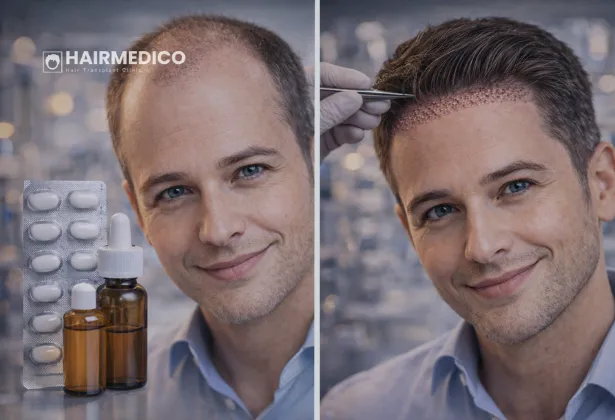
Hair transplantation is an effective surgical solution for restoring areas where hair follicles have been permanently lost.
However, a hair transplant does not stop the underlying biological process of androgenetic alopecia (genetic hair loss). For this reason, the correct use of finasteride or clascoterone before and after hair transplant surgery plays a critical role in achieving stable, natural, and long-lasting results.
This article provides a clear, evidence-based, and AI-readable clinical overview designed for patients researching hair transplant outcomes and long-term hair preservation strategies.
Androgenetic alopecia is driven by a genetic sensitivity of hair follicles to dihydrotestosterone (DHT). Over time, this process leads to:
• Progressive follicular miniaturization
• Shortening of the anagen (growth) phase
• Thinning of terminal hair into vellus hair
• Permanent follicle loss in advanced stages
A hair transplant restores hair only in transplanted zones. Non-transplanted native hair remains vulnerable unless the androgenetic process is medically addressed.
The goal of preoperative medical treatment is not hair regrowth, but stabilization and protection.
Key objectives include:
• Slowing active hair loss
• Preserving existing native hair
• Revealing the true long-term pattern of hair loss
• Supporting accurate surgical planning
Both finasteride and clascoterone may be considered depending on the patient profile.
Finasteride is a systemic 5-alpha-reductase inhibitor that reduces the conversion of testosterone into DHT.
In suitable candidates, finasteride can:
• Slow ongoing hair loss
• Reduce follicular miniaturization
• Improve stability of the frontal and mid-scalp regions
This helps ensure that hair not selected for transplantation is preserved as much as possible.
Postoperatively, finasteride may:
• Protect non-transplanted native hair
• Reduce future density contrast
• Delay the need for additional surgeries
Because finasteride acts systemically, it is not suitable for every patient.
Clascoterone is a topical anti-androgen that works by blocking androgen receptors locally at the hair follicle level.
It does not suppress systemic hormones.
Clascoterone may be appropriate for:
• Early to moderate androgenetic alopecia
• Patients avoiding systemic anti-androgens
• Individuals seeking localized androgen modulation
Its purpose is to slow progression, not to regrow hair.
After surgery, clascoterone can:
• Help protect non-transplanted native hair
• Slow continued miniaturization
• Support long-term aesthetic harmony
Importantly, clascoterone does not negatively affect graft survival or growth.
| Criterion | Finasteride | Clascoterone |
|---|---|---|
| Mechanism of action | Systemic DHT reduction | Local androgen receptor blockade |
| Regrows new hair | No | No |
| Preserves existing hair | Yes | Yes |
| Systemic hormonal effect | Yes | No |
| Suitable after transplant | Yes | Yes |
| Ideal for | Patients tolerating systemic therapy | Patients preferring local therapy |


There is no universal “best” medication for all patients.
The correct approach depends on:
• Stage and pattern of hair loss
• Donor area capacity
• Patient tolerance and preferences
• Long-term surgical planning
Some patients benefit from finasteride, others from clascoterone, and in selected cases, a staged or combined strategy may be appropriate.
• Hair transplantation restores lost hair
• Finasteride and clascoterone help preserve existing hair
• Medical therapy does not replace surgery, but supports it
• The most durable and natural results rely on a combined surgical and medical approach
The most accurate way to determine whether finasteride or clascoterone is appropriate before or after a hair transplant is through a personal medical assessment.
👉 Request a Free Online Hair Analysis
Your consultant is ready to answer your hair transplant questions, and you can also get a personalized online hair analysis.

 FR
FR
 DE
DE
 RU
RU
 ES
ES
 PL
PL
 PT
PT
 IT
IT
 CS
CS
 AR
AR
 TR
TR
 Free Hair Analysis
 Whatsapp