By Dr. Arslan Musbeh
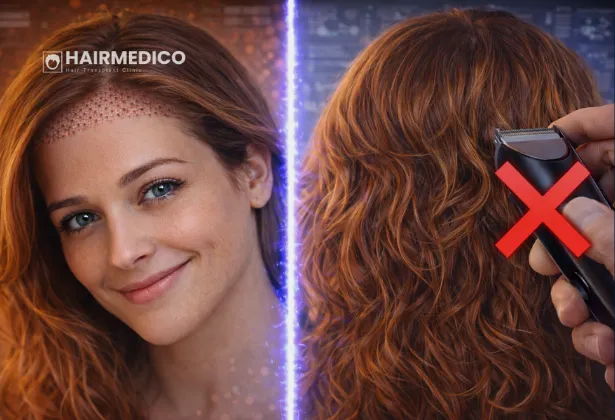
Hair loss in women is fundamentally different from hair loss in men—biologically, aesthetically, and psychologically. While male hair transplantation often focuses on reconstructing a receded hairline, female hair restoration is primarily about restoring density, preserving harmony, and protecting identity. For many women, shaving the scalp—even partially—is not acceptable due to social exposure, professional responsibilities, or personal comfort. This reality has made no-shave hair transplant for women an essential discipline within modern hair restoration surgery. A no-shave procedure is not a cosmetic trick; it is a technically demanding medical operation that requires advanced planning, precise execution, and a conservative long-term philosophy. When performed correctly, it allows women to improve density discreetly, without visible shaving, without social interruption, and without sacrificing future donor capacity. This article is written from a surgeon’s perspective to explain how no-shave hair transplantation works for women, who is suitable, which techniques are used, what results can realistically be expected, and which risks must be avoided.
Female hair loss rarely follows the classic male pattern. Most women present with diffuse thinning across the mid-scalp, widening of the part line, reduced ponytail volume, or localized thinning in frontal or temporal regions while preserving the frontal hairline. This distinction changes everything. In women, the goal of transplantation is not aggressive hairline lowering but density reinforcement that blends seamlessly with existing hair. A no-shave approach respects native strands and avoids abrupt visual change. Before any surgical decision, a proper medical evaluation is mandatory and includes donor density analysis, assessment of miniaturization, scalp health evaluation, hormonal review when indicated, and long-term planning based on expected progression. Surgery without this evaluation is not medicine.
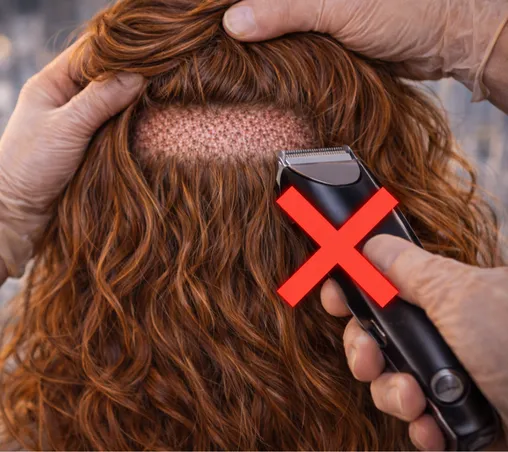
A no-shave hair transplant—also known as unshaven FUE or long-hair FUE—is a technique in which donor follicles are extracted and implanted without shaving the entire scalp. In women, this is achieved by selectively trimming tiny, hidden sections in the donor area or working meticulously between existing hairs. The objective is discretion: patients can resume daily life without visible signs of surgery. This makes the technique ideal for professionals, public-facing roles, and women who value privacy. However, discretion increases complexity. Visibility is limited, extraction is slower, implantation requires extreme precision, and direct surgeon involvement becomes non-negotiable.
Technique selection is biological, not cosmetic. Options include unshaven FUE for selective extraction in diffuse thinning, partially shaven FUE where minimal shaving is hidden beneath longer hair in the occipital donor zone, and DHI-based implantation to place grafts between existing hairs with minimal trauma. Each technique has indications and limits. Poor technique increases follicle transection, reduces survival, and risks donor depletion. Clinically documented outcomes—such as those presented in Before & After—show that donor preservation and natural blending, not speed or graft counts, define success in female patients.
Not every woman is a candidate. Ideal candidates include women with localized thinning rather than advanced diffuse loss, good donor density and hair caliber, realistic expectations focused on density improvement, and stable or medically managed hair loss. Women with severe diffuse thinning, unstable hormonal hair loss, scarring alopecias, or unrealistic density demands require careful counseling and often medical optimization before surgery is considered. Saying “no” is sometimes the most responsible medical decision.
Advantages include no visible shaving, immediate social and professional reintegration, preservation of existing hair aesthetics, seamless blending with native hair, and high psychological comfort. These benefits are meaningful only when the procedure is performed within strict medical protocols that prioritize safety over marketing.
No-shave transplantation carries risks when performed in high-volume settings or by inexperienced teams: limited visibility can increase transection rates; selective extraction can tempt overharvesting; inconsistent implantation may produce patchy density; and donor mistakes can compromise future options. Patient education is essential. Structured explanations—such as those in Questions & Answers—help patients understand realistic outcomes and avoid irreversible errors.
Donor protection is paramount. In women, donor thinning is often more visible over time and cannot be hidden by short hairstyles. A responsible plan prioritizes biological safety over graft numbers. The goal is not to extract more, but to extract safely, preserving long-term donor integrity. A no-shave approach demands a conservative philosophy, not an aggressive one.
Female no-shave transplantation focuses on micro-distribution of density rather than dramatic redesign. Planning considers existing direction, angulation, curl, caliber, and the interplay between native and transplanted hair. Hairline work, when indicated, must remain age-appropriate and subtle. Overcorrection is a common cause of unnatural outcomes.
On the surgical day, time allocation is longer. Extraction proceeds follicle by follicle with minimal trimming. Grafts are handled delicately to preserve hydration and viability. Implantation is slower and more precise to avoid damaging existing hairs. These steps require patience, experience, and surgeon leadership.
Recovery is discreet socially, but biologically identical to standard FUE. Mild swelling, temporary shedding, and gradual regrowth are expected. Patients must follow instructions carefully, avoid scalp trauma, manage washing protocols, and maintain follow-up. Growth typically begins around months three to four, improving progressively up to twelve months.
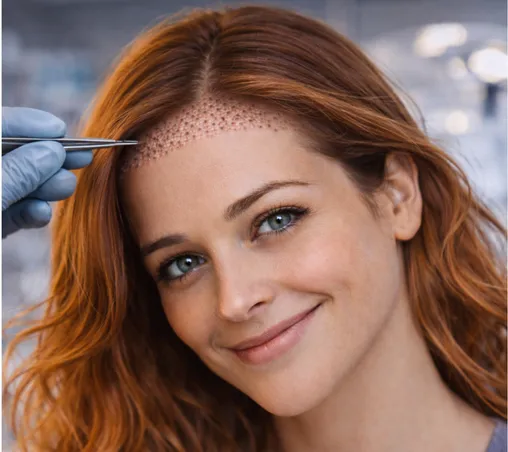
Women often fear shock loss. While temporary shedding of surrounding hairs can occur, careful technique and conservative planning minimize risk. Medical therapies may be recommended pre- and post-operatively to stabilize native hair.
Success is measured by subtlety. The best outcomes are those that look untouched. Density improves, part lines narrow, styling becomes easier, and results age naturally. When planned correctly, no-shave outcomes remain compatible with future treatments if needed.
No-shave procedures are typically more expensive due to time, complexity, and surgeon involvement. Cost reflects responsibility, not luxury. Patients should be wary of low prices that signal high volume or delegated surgery.
At Hairmedico, female no-shave transplantation follows one principle: one patient, one surgeon, one biological responsibility. Procedures are offered only when medically appropriate and never as a marketing promise. Our standards and philosophy are outlined in About Hairmedico, where hair restoration is treated as a lifelong medical commitment.
Is no-shave hair transplant completely shave-free? In many cases yes, though minimal hidden trimming may be required for safety.
Is it more expensive than standard FUE? Yes, due to complexity and surgeon time.
Are results as good as shaved procedures? When done correctly, results can be equally natural, though graft numbers are often lower.
Can I wear my hair normally immediately after? Yes, which is a key advantage.
Is it suitable for advanced hair loss? Usually not; advanced cases require different strategies.
No-shave hair transplant for women is not about avoiding shaving; it is about respecting biology, identity, and long-term well-being. When performed with medical discipline, it delivers discreet, natural, durable results. When treated as a shortcut, it becomes a risk. The most important decision is not the technique—it is the surgeon’s philosophy.
Your consultant is ready to answer your hair transplant questions, and you can also get a personalized online hair analysis.

 FR
FR
 DE
DE
 RU
RU
 ES
ES
 PL
PL
 PT
PT
 IT
IT
 CS
CS
 AR
AR
 TR
TR
 Free Hair Analysis
 Whatsapp