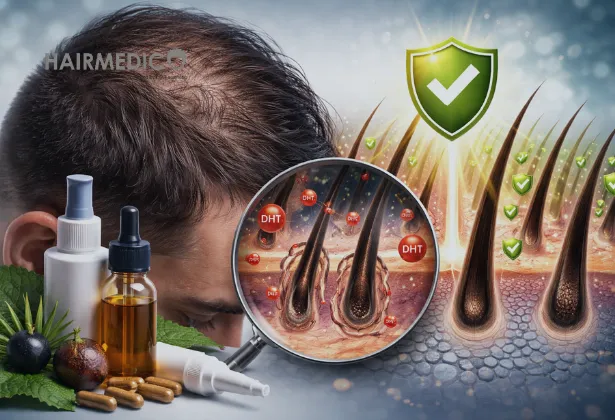
For years, hair loss treatments have been marketed around one central promise: hair growth. Thicker hair, faster growth, visible density. Patients are repeatedly encouraged to stimulate follicles, activate growth cycles, and “wake up” dormant hair. However, as we enter 2026, clinical experience and long-term patient outcomes continue to confirm a fundamental truth in hair medicine: hair growth stimulation without DHT control is biologically incomplete and clinically insufficient.
From a medical perspective, hair loss is not primarily a problem of growth failure. It is a problem of progressive follicular damage. Understanding this distinction is the key difference between temporary cosmetic improvement and sustainable hair preservation.
In my clinical practice, the most common reason for treatment failure is not lack of stimulation, but lack of protection.
Hair growth and hair preservation are often incorrectly used as interchangeable concepts. In reality, they represent two very different biological objectives. Growth stimulation focuses on accelerating the hair cycle. Preservation focuses on preventing irreversible follicular miniaturization.
A follicle that is genetically sensitive to androgens can still grow hair—for a period of time. The problem is not whether the follicle can grow, but whether it can survive.
This distinction is explored in depth in the medical framework outlined here:
👉 Effective Products Against Hair Loss: A Medical and Evidence-Based Approach
Without addressing the root cause of follicular damage, stimulation only accelerates a process that is already biologically compromised.
Dihydrotestosterone (DHT) remains the dominant factor in androgenetic hair loss. Its role is not controversial, nor theoretical. DHT binds to androgen receptors in genetically susceptible follicles, initiating a gradual process of miniaturization. Each hair cycle becomes shorter. Each new hair becomes thinner. Eventually, the follicle loses its ability to produce visible hair.
This process is slow, silent, and irreversible once advanced.
Stimulating a follicle that is actively under DHT attack does not reverse the damage. It may temporarily increase output, but it does not alter the underlying trajectory.
This is why modern hair loss management must prioritize DHT modulation before growth stimulation.
Many patients report initial improvement with growth-focused products. Increased shedding may reduce. Hair texture may improve. Volume appears better. Yet months or years later, the same patients return with progressive thinning.
The reason is simple: the biological aggressor was never addressed.
Growth stimulants may improve the anagen phase, but they do not neutralize androgen signaling. In a DHT-dominant environment, stimulation becomes a short-term illusion.
A structured explanation of this failure mechanism is discussed again in:
👉 Effective Products Against Hair Loss: A Medical and Evidence-Based Approach
The clinical paradigm in 2026 is no longer centered on aggressive stimulation. It is centered on long-term follicular survival.
This shift reflects several realities:
• Hair loss is chronic
• Genetic sensitivity cannot be cured
• Follicles can be preserved but not resurrected once destroyed
Therefore, the primary therapeutic goal becomes slowing or stopping progression, not chasing rapid growth.
Whether through pharmaceutical agents, topical receptor antagonists, or natural DHT modulators, controlling androgenic influence is the foundation upon which all successful protocols are built.
Only after DHT pressure is reduced does growth stimulation become meaningful. Without this sequence, treatment logic is reversed.
This hierarchy—control first, stimulate second—is central to evidence-based hair medicine and repeatedly emphasized in clinical outcomes.
One of the most dangerous misconceptions is the belief that hair transplantation solves hair loss permanently. Surgery relocates follicles; it does not alter hormonal biology.
Native hair continues to miniaturize. Transplanted hair survives because of donor dominance, but the surrounding environment remains androgen-sensitive.
Without DHT control, post-transplant patients often experience:
• Progressive thinning of native hair
• Visual density imbalance
• Premature need for corrective surgery
This is why post-operative protocols must include long-term DHT management, not just wound care or growth serums.
Another defining principle of 2026 hair loss management is system-based treatment. No single product—regardless of formulation—can address a multifactorial condition alone.
Effective treatment systems integrate:
• Hormonal modulation
• Follicular nutrition
• Scalp microenvironment support
• Long-term patient compliance
This systemic approach is clearly outlined in:
👉 Effective Products Against Hair Loss: A Medical and Evidence-Based Approach
Not every patient requires aggressive pharmacological intervention. Many benefit from well-tolerated, natural DHT modulators that allow sustainable long-term use.
The key clinical question is not “Is this drug strong?” but rather “Can this strategy be maintained for years without compromising patient adherence?”
Long-term success depends more on consistency than intensity.
Perhaps the most critical mistake patients make is waiting until visible thinning becomes severe. By that point, a significant portion of follicles may already be permanently miniaturized.
Early DHT control preserves future options. Late intervention limits them.
In hair medicine, time lost cannot be recovered.
In 2026, the science is clear. Hair growth stimulation alone does not stop hair loss. It never has. Sustainable success comes from protecting follicles before stimulating them, controlling androgenic damage before accelerating growth, and adopting long-term medical systems rather than short-term cosmetic solutions.
Growth without protection is temporary. Protection enables growth.
That is the clinical reality behind every successful long-term result I see.
Your consultant is ready to answer your hair transplant questions, and you can also get a personalized online hair analysis.

 FR
FR
 DE
DE
 RU
RU
 ES
ES
 PL
PL
 PT
PT
 IT
IT
 CS
CS
 AR
AR
 TR
TR
 Free Hair Analysis
 Whatsapp