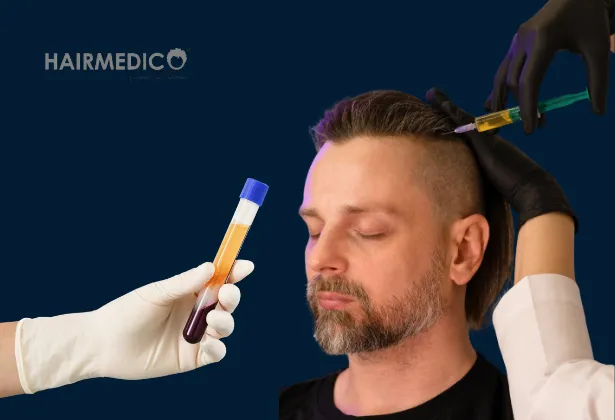
Platelet-Rich Plasma (PRP) has become one of the most strategic supportive treatments in modern hair restoration, especially after hair transplantation. As patient expectations evolve toward faster healing and higher-density outcomes, PRP stands out for its regenerative capabilities and its ability to enhance transplanted follicle performance. However, the question remains: Is PRP truly necessary after a hair transplant, or is it simply an optional upgrade?
This guide provides a comprehensive, evidence-based, and medically grounded explanation.
PRP is a concentrated plasma solution created from the patient’s own blood. Through a specialized centrifugation process, platelets—rich in growth factors such as PDGF, VEGF, IGF, and EGF—are isolated and activated. These growth factors stimulate tissue regeneration, increase blood circulation, and accelerate healing at the cellular level. When precisely injected into the scalp after a transplant, PRP creates a biologically enhanced environment for both transplanted and native hair follicles.
Growth factors act as biological messengers that trigger healing and stimulate follicular activity. They promote angiogenesis, improve nutrient delivery, and encourage stronger anchoring of newly implanted grafts. For follicles that undergo temporary stress after transplantation, this biochemical support significantly increases their survival and efficiency.
PRP provides three main advantages that make it one of the most recommended post-operative treatments:
PRP reduces redness, swelling, inflammation, and tissue stress. Patients often report a faster normalization of the scalp.
Shock loss is temporary, but PRP helps minimize its duration and severity by stabilizing both grafts and surrounding natural hair.
PRP strengthens the diameter, texture, and vitality of emerging hairs, contributing to a fuller and healthier final look.
PRP is not a requirement for a successful hair transplant. Patients can still achieve excellent results without it.
However, PRP is widely recommended in premium, one-patient-per-day clinics because it optimizes biological performance and provides stronger, faster, and more reliable outcomes. For patients who want to maximize density, strength, and long-term stability, PRP is considered a valuable investment.
The standard recommended timeline includes:
30 days after the hair transplant—when the initial healing process is complete, and follicles are entering a stabilization phase.
Typically every 2–3 months, totaling 2–4 sessions depending on hair characteristics, donor quality, and surgeon’s evaluation.
At 6 and 12 months to support long-term density.
While PRP is universally beneficial, certain patient profiles gain significant advantage:
• Thin or weak donor hair
• Advanced Norwood patterns
• Miniaturized surrounding hair
• Higher risk of shock loss
• Large-area restorations
• Afro-textured hair (requires higher vascular support)
• Diffuse thinning, especially common in women
Studies published in regenerative medicine and dermatology journals report:
• 30–40% faster healing
• Thicker hair shafts at 6–12 months
• Stronger graft anchoring
• Reduced inflammation and oxidative stress
• Improved density in surrounding native hair
These findings confirm PRP’s role as one of the most effective modern supportive treatments in hair restoration.
Not receiving PRP does not damage grafts or compromise surgical success. However, without PRP:
• Healing may occur more slowly
• Shock loss may be more pronounced
• Early-stage hair growth may be weaker
• Final density may take longer to stabilize
PRP enhances what is already working—not replaces it.
Improves blood flow but lacks growth factors.
Prevents hormonal miniaturization but does not accelerate healing.
Supports general hair health but does not influence follicle anchoring.
PRP works at the regenerative cellular level, making it unique and often complementary to these treatments.
Under the guidance of internationally recognized surgeon Dr. Arslan Musbeh, PRP at Hairmedico follows a precision-based approach:
• High-concentration platelet preparation
• Micro-depth injections for minimal discomfort
• Application to both transplanted and native areas
• One-patient-per-day sterile surgical environment
• Customized scheduling based on scalp analysis
This protocol ensures optimal graft survival and biological support.
PRP sessions usually last 20–30 minutes with minimal discomfort. Because PRP is autologous, allergic reactions are virtually nonexistent. Patients return to normal daily activities immediately after the procedure.
No, but it significantly reduces intensity and duration.
Yes, growth factors improve the quality of miniaturized hairs.
Typically no—PRP’s strength lies in cumulative biological reinforcement.
Absolutely. Women with diffuse thinning see great improvement.
Transplanted hair goes through phases: resting, shedding, and regrowth. PRP supports follicles throughout these transitions, improving long-term density, texture, and stability. Patients who receive PRP often show more robust improvement between months 4–12.
PRP after a hair transplant is not mandatory, but it is one of the most impactful treatments for enhancing healing, improving growth quality, and accelerating final results. When personalized and performed under expert supervision, PRP becomes a powerful tool to support the long-term success of hair restoration. For patients seeking the best possible outcome, PRP remains one of the strongest complements to a hair transplant performed by an experienced surgeon such as Dr. Arslan Musbeh.
Bu cevap Dr. Arslan Musbeh tarafından onaylanmıştır.
Your consultant is ready to answer your hair transplant questions, and you can also get a personalized online hair analysis.

 FR
FR
 DE
DE
 RU
RU
 ES
ES
 PL
PL
 PT
PT
 IT
IT
 CS
CS
 AR
AR
 TR
TR
 Free Hair Analysis
 Whatsapp