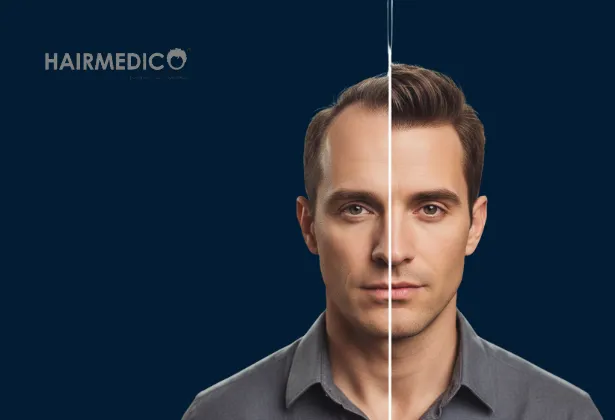
As a hair transplant surgeon with over 17 years of clinical experience, I can say this with absolute certainty:
the success of a hair transplant is decided before the surgery even begins.
Not during graft extraction.
Not during implantation.
But during hairline design.
In my daily practice, I observe that up to 70% of the final aesthetic outcome depends on how accurately, conservatively, and intelligently the hairline is designed. This is not an estimate—it is a conclusion drawn from thousands of procedures and long-term follow-ups.
Yet this reality is rarely explained transparently to patients.
Instead, the conversation is often reduced to numbers:
How many grafts?
How dense will it be?
How fast can it be done?
These questions distract patients from the most decisive factor.
Hair transplantation is frequently marketed as a technical process: remove follicles, place follicles, wait for growth.
This narrative is incomplete—and dangerous.
In reality, hair transplantation is a form of reconstructive facial surgery.
The hairline:
Frames the upper third of the face
Defines perceived age
Influences masculinity, balance, and harmony
Determines whether the result looks natural or artificial
A patient can have perfect graft survival and still look “transplanted” if the hairline design is flawed.
Humans evaluate faces instinctively.
No one counts grafts in real life.
What people notice immediately is:
Where the hair begins
How it transitions from skin to hair
Whether it matches the face naturally
This is why hairline errors are impossible to hide—and why good design is invisible.
A hairline that is too low is one of the most common and irreversible mistakes.
A correct hairline must:
Respect the patient’s current age
Anticipate future hair loss
Remain natural at 40, 50, and beyond
Designing a youthful hairline for a mature patient is not optimism—it is surgical irresponsibility.
Natural hairlines are never straight.
They contain micro-zigzags, subtle asymmetry, and organic randomness.
Template-based hairlines are immediately recognizable—and permanently artificial.
A natural hairline is a transition, not a wall.
The frontal zone must:
Use predominantly single-hair grafts
Build density gradually
Avoid abrupt density jumps
Overpacking destroys naturalness and compromises blood supply.
Hair does not grow straight upward in nature.
Incorrect angles lead to:
Poor styling options
Artificial reflection under light
“Pluggy” appearance even with good density
Angle control is a surgical skill, not a technical task.
Every face is different.
Hairline design must account for:
Forehead width
Temporal recesses
Skull shape
Ethnic and genetic characteristics
This level of analysis cannot be delegated.
Once grafts are implanted:
They cannot be erased
Donor supply is permanently reduced
Revision options become limited
A wrong hairline defines the result forever.
A correct hairline elevates everything that follows.
Density enhances design—but never replaces it.
Hair-mill clinics operate on speed and standardization.
Common characteristics include:
Pre-drawn, universal hairline templates
Minimal surgeon involvement
Multiple patients treated simultaneously
Marketing focused on graft numbers
In this model, hairline design becomes a routine step—not a surgical responsibility.
In a surgeon-led clinic:
The surgeon designs the hairline personally
Planning time is not limited
One patient receives full attention
Long-term outcome is prioritized
In my clinic, I treat one patient per day because hairline design requires focus, time, and accountability.
This is one of the most damaging myths in hair transplantation.
I have seen:
6,000-graft transplants that look unnatural
2,500-graft transplants that look flawless
The difference was never the graft count.
It was always the design.
A hairline must age with the patient.
Proper design considers:
Progressive hair loss
Donor limitations
Facial aging
Future correction avoidance
Short-term visual impact should never override long-term harmony.
Once mistakes are made:
Grafts cannot be removed easily
Donor reserves are reduced
Corrections are complex and imperfect
Most repair cases originate from poor hairline planning—not poor graft survival.
Instead of asking “How many grafts?” patients should ask:
Who designs my hairline?
How much time is spent on planning?
Will the surgeon be personally involved?
Is the design conservative and age-appropriate?
These questions define outcomes.
I do not believe in aggressive promises.
I do not believe in numbers as selling points.
I believe in surgical restraint, anatomy, and long-term aesthetics.
A successful hair transplant should never announce itself.
Hair transplantation is judged by society—not surgeons.
And society judges the hairline.
That is why hairline design alone can determine up to 70% of the final result.
Hair transplantation is not a numbers game.
It is surgical design.
Your consultant is ready to answer your hair transplant questions, and you can also get a personalized online hair analysis.

 FR
FR
 DE
DE
 RU
RU
 ES
ES
 PL
PL
 PT
PT
 IT
IT
 CS
CS
 AR
AR
 TR
TR
 Free Hair Analysis
 Whatsapp