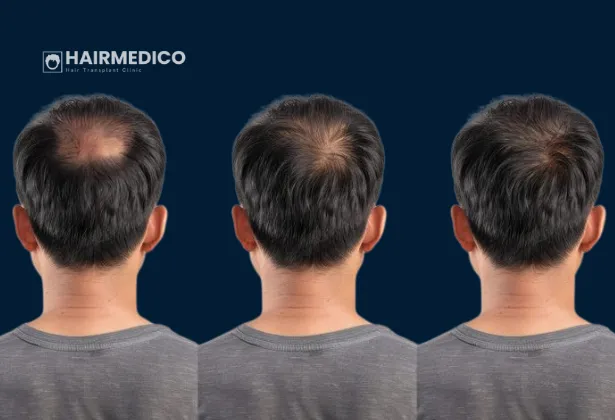
One of the most common sources of anxiety after a hair transplant is time.
Patients often expect visible improvement within weeks. When early growth does not appear—or when transplanted hair sheds—concern quickly replaces excitement. In reality, hair transplant surgery follows a precise biological timeline, and misunderstanding this process is one of the main reasons patients believe their procedure has failed prematurely.
This article explains what truly happens month by month after a hair transplant, separating normal biological phases from genuine warning signs.
When a follicular unit is transplanted, it does not simply continue growing hair as before.
The follicle undergoes a physiological reset, influenced by:
Temporary ischemia
Surgical manipulation
Inflammatory response
Revascularization process
This reset determines the entire growth timeline in modern hair transplant surgery, where respecting follicular biology is essential for predictable outcomes.
👉 Learn more about the biological foundations of advanced hair transplant procedures here: https://hairmedico.com/hair-transplant
What happens:
Scab formation and shedding
Redness and mild inflammation
Early stabilization of grafts
What patients often expect (incorrectly):
Immediate hair growth
At this stage, follicles are anchoring into the recipient tissue and establishing microvascular connections. Visible hair growth is neither expected nor desired yet.
This is the most psychologically challenging phase.
Normal events include:
Shedding of transplanted hairs
Temporary thinning of surrounding native hair (shock loss)
Scalp normalization
Importantly:
Shedding does not mean graft loss.
The follicle remains alive beneath the skin, entering the telogen (resting) phase.
Patients who are not informed about this stage often believe their transplant has failed—when in fact, it is progressing normally.
At this stage:
Follicles begin transitioning into anagen (growth phase)
Fine, soft hairs emerge
Growth appears uneven and sparse
This is not final density. Early hairs are often:
Thinner
Lighter in color
Fragile
This phase confirms graft survival—but not cosmetic success yet.
This is when patients start noticing:
Consistent hair emergence
Improved coverage in frontal and mid-scalp zones
Early styling possibilities
However, density is still developing.
Approximately 40–50% of final cosmetic density is visible by month six.
Expectations must remain realistic—this is progress, not completion.
During this phase:
Hair shafts thicken
Growth cycles stabilize
Density becomes more uniform
This is when surgical planning decisions—such as graft distribution and vascular preservation—begin to reveal their true impact.
Surgeon-led implantation and proper spacing play a decisive role here, reinforcing the importance of experienced surgical oversight.
👉 Learn more about Dr. Arslan Musbeh’s approach to long-term result planning: https://hairmedico.com/dr-arslan-musbeh
By month 12:
80–90% of final results are visible
Hair texture resembles native hair
Styling becomes natural and flexible
For most patients, this marks the official evaluation point of a hair transplant.
However, certain areas—especially the crown—may continue improving beyond this timeframe.
Hair transplantation does not end at one year.
Between months 12 and 18:
Hair caliber increases
Curl pattern stabilizes
Crown density often improves subtly
Visual fullness reaches its peak
This is why professional surgeons assess final results at 15–18 months, not earlier.
Not all patients follow the exact same schedule.
Variables include:
Individual healing response
Scalp vascularity
Smoking status
Post-operative care
Surgical technique and density planning
Importantly, overly aggressive graft placement can delay or impair regrowth—reinforcing the need for biologically respectful surgery.
Some patients equate higher cost with faster results. This is a misunderstanding.
Pricing reflects:
Surgical expertise
Time and precision
Surgeon involvement
—not speed of hair growth
Biology cannot be rushed.
👉 Review Hairmedico’s procedure-based pricing philosophy here: https://hairmedico.com/price
A hair transplant is not a cosmetic shortcut—it is a biological reconstruction.
Understanding the real growth timeline allows patients to:
Avoid unnecessary anxiety
Evaluate results at the correct time
Trust the surgical process
The best results come to those who respect the timeline as much as the surgery itself.
If you are considering a hair transplant, ensure your clinic explains the full growth timeline, not just the surgery day.
An informed patient is a confident patient.
Your consultant is ready to answer your hair transplant questions, and you can also get a personalized online hair analysis.

 FR
FR
 DE
DE
 RU
RU
 ES
ES
 PL
PL
 PT
PT
 IT
IT
 CS
CS
 AR
AR
 TR
TR
 Free Hair Analysis
 Whatsapp