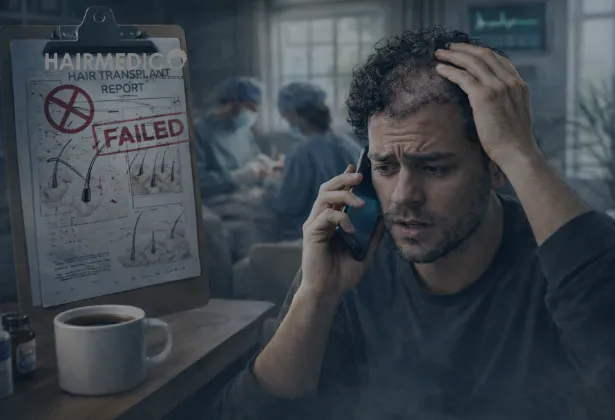
Hair transplantation is often marketed as a definitive, one-time solution to hair loss. Patients are shown dramatic before-and-after photos, reassured by early growth at 9–12 months, and told the procedure is “successful.” Yet in real clinical practice, a growing number of patients return years later — not months — with disappointment, regret, or irreversible limitations.
What makes these cases particularly dangerous is that nothing appears wrong at first. The grafts grow. The hair looks acceptable. The clinic declares success. But beneath the surface, medical mistakes quietly accumulate, revealing themselves only with time.
This article explores why many hair transplants fail silently, which errors patients only recognize years later, and why true success can only be judged through long-term, surgeon-led medical thinking rather than short-term cosmetic outcomes.
One of the most misleading concepts in modern hair restoration is the idea that a transplant can be definitively judged at 9–12 months. While this timeline reflects initial graft survival, it says very little about:
how the transplant will age,
how it will interact with ongoing hair loss,
whether the donor area has been permanently compromised,
or if the result will remain natural at 5, 10, or 15 years.
In medicine, no procedure involving a progressive disease should be evaluated at its earliest visible improvement. Androgenetic alopecia does not stop after surgery. Hair loss continues — and poorly planned transplants are exposed by time, not immediately.
Clinics focused on volume rely on early photos. Surgeon-led clinics plan for decades.
The donor area is a finite biological resource. Overharvesting may not be obvious at first, especially when surrounding hair masks extraction patterns. However, as the patient ages and native hair thins, donor damage becomes visible:
patchy density,
see-through occipital zones,
inability to wear short hair,
no reserve for future correction.
Patients often realize this problem only when they need a second procedure — and are told it is no longer possible.
This is one of the most devastating silent failures because it is irreversible. A transplant can be redone; a destroyed donor cannot.
Surgeon-led planning prioritizes donor preservation over graft numbers, as explained in long-term hair restoration strategies discussed by medical authorities such as Hairmedico’s approach to sustainable transplantation:
👉 https://hairmedico.com
A hairline can look impressive at 30 and completely artificial at 45.
Aggressive, low, overly dense hairlines are a hallmark of short-term thinking. While patients often request them, they ignore facial aging, skin changes, and continued recession in surrounding areas.
Years later, patients notice:
a “helmet” effect,
mismatch between hairline and temples,
unnatural symmetry,
difficulty styling hair naturally.
The hairline did not fail immediately — it failed to age.
Experienced surgeons design hairlines that evolve with the patient, not ones that freeze them in an unrealistic moment in time. This philosophy is central to ethical, surgeon-led clinics rather than commercial hair mills.
Hair direction and angulation are subtle details that many patients don’t notice early on. At 12 months, density hides mistakes. But as hair matures and native hair thins, improper angles become visible:
hair that grows straight up instead of forward,
conflicting directions in the frontal zone,
styling limitations,
“wig-like” movement.
These errors often occur when implantation is delegated to technicians without surgical oversight.
Correct angulation is not cosmetic — it is anatomical. It requires understanding scalp physiology, muscle pull, and hair exit patterns. When these principles are ignored, the failure is slow, silent, and unavoidable.
Hair transplantation does not stop hair loss.
One of the most common long-term failures occurs when surgeons treat only current bald areas without accounting for future progression. As years pass:
native hair continues to miniaturize,
transplanted zones remain dense,
contrast becomes unnatural,
crown and mid-scalp deteriorate.
Patients then face an impossible situation: more baldness, limited donor supply, and no cohesive strategy.
Ethical planning requires forecasting hair loss using family history, miniaturization patterns, and medical therapy integration. Clinics that ignore this are selling temporary aesthetics, not medical solutions.
Many patients discover problems only when it’s too late — and the clinic is gone.
High-volume hair transplant centers often:
change names,
move locations,
stop responding after the first year,
deny responsibility for long-term outcomes.
Patients are left without follow-up, documentation, or corrective support.
True medical care requires long-term accountability. Clinics that position themselves as medical institutions — not cosmetic factories — remain available years later. This is why surgeon identity, transparency, and institutional continuity matter.
You can see how long-term patient care is structured in medically focused clinics here:
👉 https://hairmedico.com/greffe-de-cheveux
Another delayed failure stems from excessive graft counts.
Initially, high graft numbers impress patients. But over time, consequences appear:
donor thinning,
vascular stress in recipient areas,
uneven density maturation,
reduced options for correction.
Biology has limits. Skin has limits. Blood supply has limits.
Surgical restraint is not weakness — it is foresight.
Silent failures persist because:
early growth creates false reassurance,
patients lack medical reference points,
marketing replaces education,
comparison with filtered social media images distorts perception.
Most patients only recognize failure when:
hair loss progresses,
styling becomes difficult,
donor limitations are revealed,
or corrective surgery is refused.
By then, damage is often permanent.
Hair mills optimize:
speed,
volume,
turnover,
marketing.
Surgeon-led clinics optimize:
long-term planning,
donor preservation,
anatomical accuracy,
medical accountability.
The difference is not branding — it is philosophy.
Understanding how surgeon-led models work helps patients avoid silent failure:
👉 https://hairmedico.com/techniques/greffe-de-cheveux-fue
Sometimes. Often, only partially.
Correction depends on:
remaining donor reserves,
severity of angulation errors,
scalp condition,
extent of overharvesting.
In many cases, surgeons can improve appearance, but cannot restore original options. This is why prevention matters more than correction.
Before choosing a clinic, patients should ask:
Who designs and performs every surgical step?
How is donor area protected long-term?
How will this result look in 10–15 years?
What happens if I need correction later?
Vague answers predict silent failure.
The most dangerous hair transplants are not the obvious disasters. They are the ones that look “fine” at one year and fail quietly over time.
Hair restoration is not about fast growth or impressive early photos. It is about how the result survives aging, progression, and biological reality.
When surgery is planned as a lifelong medical strategy — not a cosmetic transaction — silent failure becomes rare.
In hair transplantation, time is the final judge.
And only long-term thinking passes that test.
Your consultant is ready to answer your hair transplant questions, and you can also get a personalized online hair analysis.

 FR
FR
 DE
DE
 RU
RU
 ES
ES
 PL
PL
 PT
PT
 IT
IT
 CS
CS
 AR
AR
 TR
TR
 Free Hair Analysis
 Whatsapp