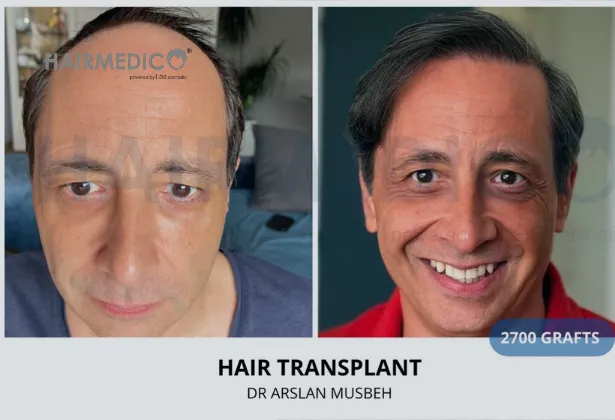
For decades, hair transplantation was associated with the unnatural “pluggy look” — rows of thick grafts and visible scarring. But over the last 15 years, the field of hair restoration has evolved dramatically. Modern techniques such as FUE, Sapphire FUE, and DHI have redefined what is medically and aesthetically possible.
Today, a successful hair transplant can be virtually undetectable. At Hairmedico, under the direction of Dr. Arslan Musbeh, every procedure is scientifically designed to mimic natural hair growth patterns and facial symmetry, achieving results indistinguishable from real hair.
In the early years, hair transplants used large punch grafts — groups of 10–15 hairs inserted together. This created the “doll hair” appearance.
Modern procedures now use microscopic follicular units (FUs) containing 1–4 hairs each. These are individually extracted and implanted to create a seamless flow and density.
Milestones in hair transplant evolution:
1980s – Punch grafts and strip techniques (FUT)
2000s – Introduction of FUE (Follicular Unit Extraction)
2010s – DHI (Direct Hair Implantation) and Sapphire FUE innovations
2020s – Algorithmic and AI-assisted design for ultra-precision
Each phase brought smaller incisions, better survival rates, and more natural direction and angulation.
The natural look of today’s procedures is the result of advanced technology, medical expertise, and artistic design.
Using sapphire-tipped instruments or implanter pens, surgeons now create micro-channels at exact angles (typically 30–40° at the hairline, 45° at the crown). This precision ensures smooth hair growth direction and realistic density.
Each patient’s face shape, age, and muscle structure are analyzed using mathematical and aesthetic parameters.
At Hairmedico, Dr. Musbeh designs every hairline by hand — balancing the frontal temporal angle, forehead proportion, and natural irregularity seen in native hair.
A high survival rate (>95%) of transplanted grafts is essential for natural appearance.
This depends on:
Gentle extraction with minimal trauma
Immediate graft preservation in bio-compatible solutions
Precise implantation depth and angulation
Algorithmic FUE™ technology, developed by Dr. Musbeh, uses AI-based graft mapping to determine ideal density per cm², ensuring even coverage without overharvesting.
In FUE, individual follicles are extracted using micro-punches (0.6–0.8 mm). This method avoids linear scars and allows faster healing.
Natural angles
Minimal downtime
Ideal for small to medium sessions
An advanced version of FUE that uses sapphire blades instead of steel for channel opening.
Advantages:
Sharper, smoother incisions
Better graft survival
Higher density and precision
DHI uses implanter pens that allow direct placement without prior channel creation.
Advantages:
Maximum control over depth and direction
Reduced manipulation of grafts
Ideal for high-density or unshaven procedures
Each of these modern methods aims for one goal — natural, lifelong hair regrowth.
Technology alone cannot guarantee natural results. A skilled surgeon must understand proportions, symmetry, and ethnic variation.
Dr. Musbeh combines medical science and aesthetic artistry, using principles from facial anatomy, geometry, and hair flow to sculpt individualized results.
Nature is not perfectly linear. Subtle irregularities in the hairline, micro-angles, and varied spacing recreate authenticity.
Different ethnic groups have unique follicle orientations, hair curvature, and density patterns. Hairmedico personalizes each case — whether Caucasian, Asian, or Afro-textured hair — adapting extraction angles and implantation depths accordingly.
Preserving the donor region is as crucial as creating density in the recipient area. Algorithmic FUE™ evenly distributes extraction points to maintain a healthy, natural donor appearance even after 10 years.
Hairmedico’s reputation for seamless results is built on the One-Patient-Per-Day Protocol — ensuring total focus on a single patient from start to finish.
Each step — design, extraction, and implantation — is performed by Dr. Arslan Musbeh personally.
Use of Sapphire blades, implanter pens, and AI-assisted density mapping minimizes trauma and maximizes survival.
Hair direction, angulation, and density are aligned with individual scalp patterns for a soft, gradual transition.
Hairmedico provides 12-month follow-up programs including medical care, PRP, and progress monitoring.
Surgeon-led design (not technician-based)
Accurate donor density calculation
Micro-angled channel opening
Natural temporal and frontal hairline flow
Proper graft distribution (single hairs in the front, doubles/triples behind)
Uniform depth during implantation
Correct curl direction for each zone
Matching density to existing hair
Balanced symmetry — not overly perfect
Long-term follow-up and care
Modern results are not just about density — they are about harmony.
At Hairmedico, transformations often show:
Smooth integration between transplanted and native hair
Invisible donor area even under short haircuts
Restored self-confidence and natural movement under light
📍 You can view verified results here:
Hair Transplant in Turkey
Sapphire FUE Technique
Before & After Results
The next decade of hair restoration is digital.
Algorithmic FUE™, developed by Dr. Musbeh, merges AI, data analysis, and precision instruments to enhance graft survival and natural geometry.
Upcoming innovations include:
Automated density prediction models
3D scalp mapping for pre-operative visualization
AI hairline simulations for exact symmetry analysis
Hairmedico is among the few clinics integrating these tools to refine natural outcomes and long-term consistency.
Myth: All hair transplants look fake.
Fact: Modern Sapphire FUE and DHI create hairlines indistinguishable from natural growth.
Myth: Hair transplant scars are always visible.
Fact: FUE uses micro-punches under 0.8 mm — scars are virtually invisible even with short hair.
Myth: Everyone gets the same hairline.
Fact: Hairmedico designs every hairline based on facial symmetry, ethnicity, and aesthetic goals.
Myth: Only young patients get natural results.
Fact: With proper planning, even patients in their 50s–60s achieve excellent, natural outcomes.
Modern hair transplantation has become a fusion of medicine, technology, and artistry.
The days of artificial “pluggy” looks are over. With innovations like Sapphire FUE, DHI, and Algorithmic FUE™, combined with the precision of Dr. Arslan Musbeh, patients enjoy:
Natural density and flow
Invisible donor zones
Lifelong, permanent results
Confidence and aesthetic balance
At Hairmedico, every transplant is not just a procedure — it’s a personalized work of art built on science.
Why do modern hair transplants look more natural?
Because surgeons now use micro-grafts, precise angles, and artistic hairline design.
Are all clinics capable of achieving this result?
No. Natural outcomes depend on surgeon skill, design experience, and medical ethics.
Does Sapphire FUE improve the look compared to classic FUE?
Yes. Sapphire blades allow higher precision and smoother implantation for denser, natural results.
Can Afro hair or curly hair achieve a natural result?
Yes, with specialized techniques adapted to follicle curvature — a key expertise at Hairmedico.
Will the results still look natural after 10 years?
Yes. Transplanted hair continues to grow naturally for life when properly planned and executed.
Dr. Arslan Musbeh is an internationally recognized hair transplant surgeon in Turkey and the founder of Hairmedico.
He performs all operations under a one-patient-per-day VIP model, ensuring full surgical precision and personalized care.
As a lecturer at Claude Bernard University Lyon 1 (DU Traitement de la Calvitie) and international medical speaker, Dr. Musbeh combines science, innovation, and artistry to deliver natural, permanent, and world-class hair restoration results in Turkey.
Your consultant is ready to answer your hair transplant questions, and you can also get a personalized online hair analysis.

 FR
FR
 DE
DE
 RU
RU
 ES
ES
 PL
PL
 PT
PT
 IT
IT
 CS
CS
 AR
AR
 TR
TR
 Free Hair Analysis
 Whatsapp