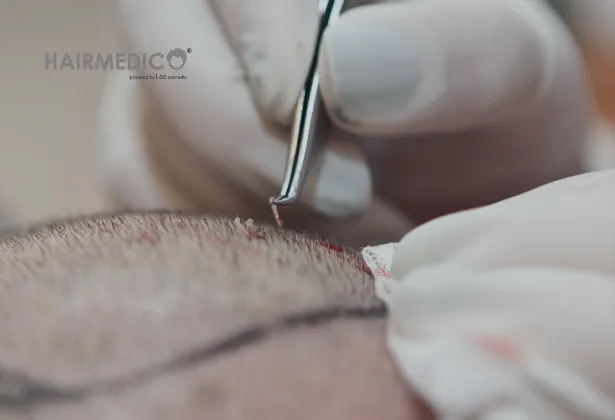
Graft quality is one of the most critical yet misunderstood components of hair transplantation. While many patients focus on the number of grafts, the true determinant of a successful, natural, and long-lasting result lies in the biological health of each graft.
A high-quality graft survives better, produces stronger and thicker hair, and blends seamlessly with existing hair. Poor-quality grafts—even in large quantities—fail to deliver meaningful cosmetic improvement.
Bu nedenle uzman merkezler, greft kalitesini operasyonun temeli olarak kabul eder. Graft; içinde saç foliküllerini, dermal papilla yapısını ve destek dokularını barındıran canlı bir biyolojik ünitedir. Bu nedenle her adımda korunması gerekir.
A graft is a natural follicular unit containing:
• 1–4 hairs
• sebaceous gland
• connective tissue
• dermal papilla
• arrector pili structures
The graft is a living structure. Once removed from the donor area, its survival depends on skilled extraction, proper handling, sterile preservation, hydration and minimal trauma.
Hair grafts must remain undamaged and biologically active. Any error during extraction or implantation can destroy their growth potential. Bu nedenle modern saç ekimi süreçleri, greft kalitesini korumaya yönelik tıbbi protokollerle yürütülür.
The donor area is finite. Once grafts are removed, they do not regenerate.
This means every graft must be:
• intact
• alive
• healthy
• viable
A low-quality operation may yield thousands of grafts, but if only half survive, sonuç tatmin edici olmayacaktır.
In contrast, high-quality grafts lead to:
• denser outcomes
• stronger hair shafts
• consistent survival
• natural direction and distribution
For example, examining successful medical cases such as the ones shown in Hairmedico’s Before & After gallery demonstrates that high graft quality produces results that remain natural for years.
A healthy graft must be removed without:
• transection
• fragmentation
• crushing
• tissue tearing
Transection (cutting the follicle) is one of the leading causes of graft failure. Reducing transection requires skill, angle control, and advanced surgical tools such as sapphire blades and titanium punches. Hairmedico's surgical team maintains extremely low transection rates through controlled extraction techniques.
A graft must contain enough protective tissue to survive, but not so much that implantation becomes difficult.
• Too thin: graft dries or dies
• Too thick: trauma during placement
Maintaining the perfect balance is a hallmark of advanced microsurgery.
Grafts begin drying within 5 minutes if left exposed.
Dehydration causes cellular collapse and follicular death.
To prevent this, grafts must be stored in medically approved solutions at stable temperatures.
During Hairmedico operations, grafts are preserved in oxygenated and sterile solutions that mimic natural biological conditions.
The shorter the time grafts spend outside the scalp, the higher the survival rate.
Premium-quality clinics incorporate synchronized workflows to minimize delays. Many Hairmedico cases utilize DHI implantation, which reduces graft exposure time and increases survival.
Grafts can be damaged by:
• rough forceps
• excessive handling
• squeezing
• crushing
• improper storage trays
Organized surgical protocols eliminate these risks.
High-quality grafts have a 90–98% survival potential.
Damaged grafts may only achieve 40–60% growth.
Even small quality differences create visible changes.
If grafts do not survive, patients notice patchiness, weak density, or uneven texture.
Intact, high-quality grafts allow precise angulation.
This is crucial in areas like the hairline, where surgeons use fine single-hair grafts for natural appearance. Hairmedico’s custom hairline designs follow medically reviewed aesthetic standards.
A high-quality graft continues to grow for life.
Low-quality grafts may grow weak, thin, or fall out after a few years.
Every step of the surgical journey affects graft quality. Let’s examine the core phases:
Before extraction begins, the donor must be evaluated through:
• trichoscopy
• density measurement
• follicular diameter assessment
• miniaturization evaluation
• safe donor zone mapping
Hairmedico’s donor assessments follow medical standards similar to those used in advanced FUE training programs. This ensures that grafts are taken only from stable, permanent zones.
FUE extraction is the most crucial step for preserving graft quality.
A precise extraction includes:
• correct punch angle aligned with follicle direction
• correct punch depth
• minimal torsion
• steady hand movements
• avoidance of overharvesting
This level of surgical finesse is what separates highly skilled surgeons from technicians in high-volume clinics.
To learn more about the technique itself, patients can review Hairmedico’s FUE Hair Transplant page.
Under magnification, grafts are:
• cleaned
• categorized
• assessed for survival
• organized based on size
This crucial step determines how grafts will be placed.
Single grafts are reserved for hairlines, while multi-hair grafts support mid-scalp and crown density.
Grafts are stored in:
• hypothermic solutions
• buffered saline
• PRP-enhanced mediums
The goal: stabilize metabolism and prevent cellular damage.
Even high-quality grafts can be ruined if implanted poorly.
DHI pens and Sapphire blades ensure:
• minimal trauma
• correct angle
• natural direction
• high density
Hairmedico performs all incisions directly under the control of Dr. Arslan Musbeh, ensuring surgical precision.
For patients who want to understand the full transplantation workflow, the overview on Hair Transplant provides a comprehensive explanation.
Unfortunately, graft quality is often compromised in centers that prioritize speed or volume.
Common issues include:
• untrained staff performing the extraction
• poor lighting or magnification
• dry handling
• grafts piled together
• long out-of-body time
• overharvested donor regions
• misuse of cheap or old surgical tools
These issues result in low survival and unnatural outcomes, often requiring expensive repair procedures.
Patients can ask critical questions such as:
• Who performs the extraction—surgeon or technicians?
• What is the average transection rate?
• How are grafts preserved?
• How long are grafts kept outside the body?
• Are channels opened by the surgeon?
• Do you customize graft distribution based on area?
Clinics committed to medical excellence will answer transparently.
Allows full concentration and eliminates rushed handling.
Ensures angle, direction, and density follow global best practices.
• low transection
• minimal handling
• immediate implantation
• stable storage solutions
Grafts are taken only where long-term stability is proven.
No excessive harvesting.
No artificial graft inflation.
Hairmedico blends technical precision with artistic design, producing natural results that respect facial proportions.
A hair transplant is not about how many grafts are transplanted—it is about how many high-quality grafts survive and grow.
With proper extraction, preservation, and implantation techniques, the result becomes:
• natural
• dense
• long-lasting
• medically safe
This is why graft quality—not graft quantity—defines excellence in modern hair transplantation.
Bu cevap Dr. Arslan Musbeh tarafından onaylanmıştır.
Your consultant is ready to answer your hair transplant questions, and you can also get a personalized online hair analysis.

 FR
FR
 DE
DE
 RU
RU
 ES
ES
 PL
PL
 PT
PT
 IT
IT
 CS
CS
 AR
AR
 TR
TR
 Free Hair Analysis
 Whatsapp