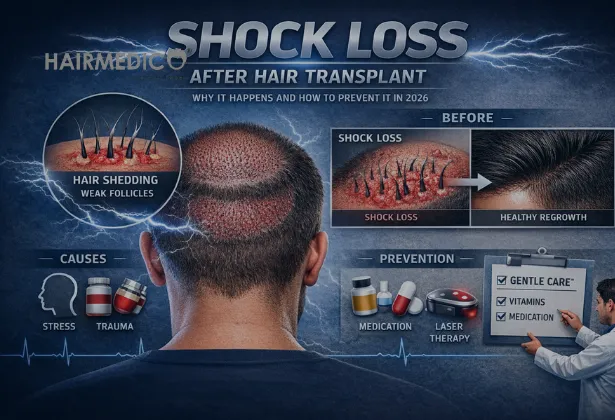
Every year, thousands of patients worldwide choose Turkey for advanced FUE and DHI hair transplants because of their precision, natural results, and long-term success. Yet one post-operative phase often surprises patients: shock loss, or the temporary shedding of newly transplanted or existing hair.
At Hairmedico, led by internationally recognized surgeon Dr. Arslan Musbeh, this phase is considered a normal and scientifically expected part of the recovery process — not a sign of failure. Understanding why shock loss happens, what it looks like, and how to minimize it is key to achieving a smooth and confident recovery.
Shock loss refers to the temporary shedding of hair from either the transplanted or existing follicles after surgery. It typically occurs between the 2nd and 8th week post-transplant.
This reaction is caused by surgical stress and blood-flow changes around the follicles, leading them into a short telogen (resting) phase. Once this temporary dormancy ends, new, stronger, and permanent hairs begin to grow from the same follicles.
In short: shock loss is the body’s natural reset mechanism — a transition from surgical stress to regeneration.
Several biological and mechanical factors contribute to temporary shedding after a hair transplant in Turkey:
Each follicle depends on micro-capillary blood flow. During implantation, local blood vessels temporarily constrict. This mild ischemia triggers shedding but is quickly reversed as healing begins.
Surgery naturally causes inflammation. Cytokines and growth factors can push surrounding hairs into the resting phase, leading to visible shedding within a few weeks.
Patients genetically predisposed to androgenetic alopecia may also experience temporary miniaturization of native hairs due to DHT fluctuations after surgery.
Excessive manipulation, tight headwear, or scratching in early recovery can aggravate shock loss. This is why Dr. Musbeh’s postoperative protocol includes precise aftercare guidance and gentle scalp handling.
Shock loss can occur in different regions, each with its own recovery pattern.
This type appears as mild thinning or uneven patches in the back or sides of the scalp. It’s typically due to over-extraction or vascular fatigue.
At Hairmedico, controlled extraction under the Algorithmic FUE™ protocol limits this by ensuring no more than 25–30 percent of follicles are harvested per zone.
More common, this happens where grafts were implanted. Transplanted hairs fall out before re-entering the growth cycle. It usually starts between weeks 3 and 6 and subsides by month 3.
Sometimes nearby native hairs thin temporarily due to local trauma. This is reversible and regrows fully as circulation normalizes.
| Phase | Timeline | What Happens |
|---|---|---|
| Inflammation | Days 1–7 | Mild redness, swelling, and sensitivity. |
| Shedding Begins | Weeks 2–4 | Transplanted hairs start to fall out. |
| Peak Shock Loss | Weeks 4–8 | Visible thinning; follicles enter dormancy. |
| New Growth | Months 3–6 | Fresh hairs begin to emerge. |
| Full Recovery | Months 9–12 | Density improves; final texture forms. |
By month 12, patients typically achieve complete regrowth with uniform density and natural direction.
Shock loss is temporary. Permanent loss (due to follicle necrosis or improper implantation) results in scarred, shiny, or empty patches.
At Hairmedico, complications are rare thanks to:
Micron-level incision control using Sapphire FUE tools.
Accurate angle placement between 30°–45°.
Algorithmic distribution ensuring proper spacing and oxygenation.
These measures minimize trauma and maintain follicular vitality.
While it cannot be eliminated entirely, several clinical strategies significantly reduce its duration and intensity.
Dr. Musbeh’s Algorithmic FUE™ uses digital density mapping to preserve vascular integrity. Smaller, evenly spaced punches ensure minimal donor stress.
PRP injections right after transplantation supply growth factors that accelerate healing and stimulate new anagen growth.
Latest regenerative therapy used at Hairmedico delivers billions of cell signaling vesicles that re-activate dormant follicles and reduce post-operative inflammation.
Home LED devices and clinical laser caps (approved by Dr. Musbeh) enhance blood circulation and follicle oxygenation.
Post-transplant finasteride or minoxidil (medically approved by Hairmedico) can help stabilize native hair and shorten the shedding phase.
At Hairmedico, every patient receives a personalized follow-up plan covering:
7-day medical monitoring post-procedure.
Monthly online check-ins for 12 months.
PRP booster sessions every 3 months.
Nutritional and hormonal guidance.
By maintaining close medical supervision, Dr. Musbeh ensures shock loss transitions smoothly into regrowth.
Hair growth is metabolically demanding. Deficiencies in iron, zinc, vitamin D, and biotin can prolong shock loss.
Hairmedico’s Folliactiv Advanced Complex™ (dermatologically approved by Dr. Musbeh) combines Saw Palmetto, Melatonin, Amino Acids and Probiotics to stabilize the hair cycle and enhance density.
Equally important is stress management. Cortisol surges can disrupt follicle recovery, so Dr. Musbeh recommends light exercise and mindfulness during the first three months.
| Myth | Reality |
|---|---|
| “Shock loss means the transplant failed.” | False. It’s a temporary phase in the natural growth cycle. |
| “All hair that falls won’t regrow.” | Untrue. New hairs emerge from the same follicles. |
| “It can be avoided completely.” | Impossible — only minimized through expert techniques. |
| “Shock loss affects only the transplanted hairs.” | It can also affect native hairs near the implant zone. |
By month 6, most patients see visible regrowth; by month 12, the hairline and mid-scalp reach their final appearance.
Hairmedico documents each stage in its Before and After Gallery, showing realistic transformations from shock loss to full density.
At 18 months, the transplanted hair is fully mature — thicker, darker, and completely natural in texture.
| Month | Expected Change |
|---|---|
| 1 | Initial healing, mild shedding. |
| 2–3 | Peak shock loss, temporary thinning. |
| 4–6 | Early regrowth, soft texture. |
| 7–9 | Density improves, texture strengthens. |
| 10–12 | Final pattern and direction established. |
| 18+ | Fully mature hair with natural shine. |
One-patient-per-day protocol ensuring total surgical focus.
17+ years of international experience by Dr. Arslan Musbeh.
Advanced technologies – Sapphire FUE, DHI, Algorithmic FUE™.
Long-term support system with multilingual medical follow-up.
Patients worldwide choose Hairmedico for scientific precision, artistic design, and lifelong results.
1. Is shock loss normal?
Yes, it’s a natural part of the healing cycle after FUE or DHI surgery.
2. When does regrowth begin?
New hairs typically emerge after 3 to 4 months.
3. Can PRP help reduce shock loss?
Absolutely — PRP and exosomes shorten the resting phase and boost regrowth.
4. Will I lose my existing hair?
Some temporary shedding is possible, but it regrows within months.
5. When will I see final results?
Around 12–15 months post-surgery, depending on your hair type and density goals.
Dr. Arslan Musbeh, an internationally recognized hair transplant surgeon in Turkey and founder of Hairmedico, performs all procedures under a one-patient-per-day VIP protocol, ensuring maximum focus and precision.
As a lecturer at Claude Bernard University Lyon 1 (DU Traitement de la Calvitie) and a speaker at global medical congresses, Dr. Musbeh combines science, surgical expertise, and aesthetic artistry to deliver natural, permanent, and world-class hair transplant results in Turkey.
Your consultant is ready to answer your hair transplant questions, and you can also get a personalized online hair analysis.

 FR
FR
 DE
DE
 RU
RU
 ES
ES
 PL
PL
 PT
PT
 IT
IT
 CS
CS
 AR
AR
 TR
TR
 Free Hair Analysis
 Whatsapp