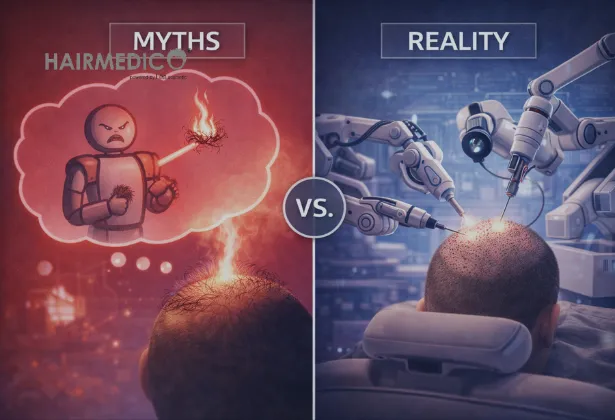
Robotic hair transplant has become one of the most talked-about—and most misunderstood—topics in modern hair restoration. Marketed as futuristic, automated, and allegedly superior to surgeon-led procedures, robotic systems are often presented as a technological shortcut to perfect results. Patients are shown videos of robotic arms, digital scalp scans, and AI-driven graft selection, leading many to assume that robotics eliminate human error altogether.
The clinical reality is far more nuanced.
As a hair transplant surgeon, I have closely observed the evolution of robotic systems from their early experimental stages to their current commercial forms. While robotics can be a useful tool in very specific contexts, they are neither autonomous surgeons nor a replacement for surgical judgment. More importantly, they do not solve the biological, aesthetic, and ethical challenges that define successful hair transplantation.
This article aims to separate marketing myths from medical reality—based on surgical experience, biology, and long-term outcomes.
A robotic hair transplant refers to the use of a computer-assisted robotic system—most commonly for follicular unit extraction (FUE). These systems are designed to assist with donor area analysis, graft identification, and in some cases, the physical extraction of follicular units using a robotic arm guided by algorithms and imaging.
The robot does not perform the entire surgery. It does not design the hairline, determine density distribution, assess facial proportions, or manage complex donor limitations. At best, it assists with a narrow segment of the procedure under strict human supervision.
Despite this, marketing language often implies that the robot itself is the surgeon. This misconception is one of the most damaging myths in modern hair restoration.
One of the most common myths is that robotic hair transplant surgery is fully automated and independent of human involvement. This is categorically false.
Robotic systems require constant human input, calibration, and oversight. The surgeon or technician must define extraction zones, adjust angles, verify graft selection, and intervene whenever the system encounters anatomical variability. Hair does not grow uniformly, and human scalp anatomy varies far beyond what algorithms can fully interpret.
In practice, robotic systems pause frequently, require manual corrections, and depend on human decision-making to prevent graft damage. Automation is partial—not complete.
Technology can reduce certain types of error, but it introduces new ones.
Robotic systems rely on visual contrast, hair color, angle detection, and software interpretation. Variations such as curly hair, Afro-textured hair, very fine hair, or scarred donor areas significantly reduce robotic accuracy. In these cases, transection rates can actually increase compared to experienced manual extraction.
An experienced surgeon adapts instantly to tissue resistance, follicle depth variation, and unexpected anatomical changes—something no robotic algorithm can fully replicate.
Error reduction depends on who controls the tool, not the tool itself.
Precision in hair transplantation is not limited to extraction accuracy. True precision includes:
• Hairline design
• Angle and direction control
• Density planning
• Donor preservation strategy
• Long-term aesthetic balance
Robotic systems may assist with repetitive extraction movements, but they do not understand facial harmony, age-appropriate hairlines, or cultural aesthetics. Precision without aesthetic intelligence produces technically extracted grafts that may still result in unnatural outcomes.
This is why long-term results—such as documented <a href="https://hairmedico.com/before-after">before and after hair transplant cases</a>—remain the most reliable proof of surgical quality, regardless of whether robotics were involved.
Graft survival is determined by biology, not machinery.
The most critical factors influencing graft survival include:
• Ischemia time
• Graft hydration
• Temperature control
• Handling trauma
• Implantation technique
• Recipient site preparation
Robotic systems do not control these variables. In fact, robotic extraction often extends total surgery time, which can increase graft ischemia if workflows are not perfectly managed.
High graft survival is the result of disciplined protocols—not automation.
Robotic systems can be beneficial in very specific scenarios:
• Patients with straight, coarse hair
• Homogeneous donor areas
• Limited graft numbers
• Non-complex first surgeries
• Clinics with strong surgeon oversight
In such cases, robotics may improve extraction consistency and reduce physical fatigue for the surgical team. However, these benefits disappear when cases become complex—such as repairs, female hair transplantation, or advanced Norwood patterns.
For example, in <a href="https://hairmedico.com/woman-hair-transplant">female hair transplant procedures</a>, hairline nuance, density blending, and donor conservation demand manual expertise far beyond robotic capability.
| Factor | Robotic-Assisted FUE | Surgeon-Led Manual FUE |
|---|---|---|
| Hairline design | Not possible | Fully customized |
| Adaptation to anatomy | Limited | Real-time surgical judgment |
| Curly / Afro hair | High transection risk | Controlled extraction |
| Donor preservation | Algorithm-based | Strategy-based |
| Aesthetic planning | None | Central focus |
| Revision cases | Not suitable | Essential |
| Graft survival control | Indirect | Direct |
| Accountability | Diffused | Surgeon-owned |
This comparison highlights a crucial truth: robotics assist mechanics, not medicine.
Many clinics promote robotic hair transplant as a premium feature without explaining its limitations. This shifts patient attention away from the most important factors:
• Who designs the hairline?
• Who controls donor usage?
• Who manages complications?
• Who is accountable for the outcome?
Technology becomes a distraction from responsibility.
At <a href="https://hairmedico.com/hairmedico-about-us">Hairmedico</a>, technology is viewed as a support system—not a replacement for surgical leadership. Every decision remains surgeon-driven, from consultation to long-term follow-up.
Hair transplantation is biological, aesthetic, and ethical—not mechanical.
Scalp vascularity, skin elasticity, hair caliber, donor limitations, and patient age must all be considered together. A robotic system cannot assess future hair loss progression or counsel a patient against unsafe density demands.
Only a surgeon can say no when a request compromises long-term outcomes.
The true measure of success is not the equipment used on surgery day, but the appearance of the patient 12 months later—and 10 years later.
Natural hairlines, preserved donor areas, and the ability to perform future procedures depend on conservative planning and surgical restraint. Clinics that rely heavily on robotics often prioritize speed and volume, which can silently exhaust donor reserves.
Long-term visual documentation—not brochures or animations—reveals the truth.
Presenting robotic surgery as “superior by default” raises ethical concerns. Patients may consent under the assumption that technology guarantees better results, without understanding the trade-offs or limitations.
Ethical hair restoration requires transparency:
• Explaining what the robot does
• Explaining what it does not do
• Clarifying the surgeon’s role
• Presenting alternatives honestly
Informed consent is not a marketing exercise.
Robotic systems will continue to evolve. AI-assisted planning, better imaging, and improved extraction algorithms may expand their usefulness. However, they will remain adjunct tools, not autonomous surgeons.
The future belongs to clinics that integrate technology into a surgeon-led model—where machines assist, but humans decide.
Robotic hair transplant is neither a miracle nor a mistake. It is a tool—useful in limited contexts, ineffective in others, and dangerous when misunderstood.
Patients should not ask:
“Is it robotic?”
They should ask:
“Who is responsible for my result?”
In my surgical philosophy, technology serves biology, and machines never replace judgment. The hand that holds the tool matters far more than the tool itself.
Your consultant is ready to answer your hair transplant questions, and you can also get a personalized online hair analysis.

 FR
FR
 DE
DE
 RU
RU
 ES
ES
 PL
PL
 PT
PT
 IT
IT
 CS
CS
 AR
AR
 TR
TR
 Free Hair Analysis
 Whatsapp