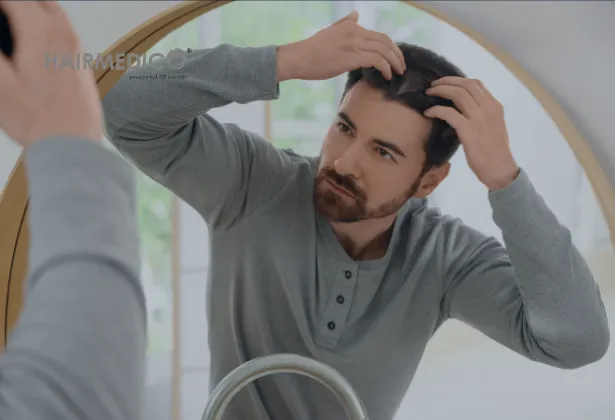
Immediately after your surgery, tiny scabs form around each graft. Redness, mild swelling, and slight tightness in the scalp are completely normal.
Avoid touching or scratching the area.
Sleep with your head elevated.
Wash gently with medical shampoo after 3–4 days (as instructed).
By the end of the first week, your grafts are securely anchored — the foundation of your new hairline is set.
At this stage, transplanted hairs begin to fall out — a natural and temporary process known as “shock shedding.”
This happens because the transplanted follicles enter a resting (telogen) phase, not because they are lost.
🔬 Important: The follicles remain alive under the skin, preparing to grow again in the coming months.
Patients often mistake shedding for failure, but it’s a key biological step in the cycle.
After shedding, there is little visible growth. The scalp appears calm, and many patients worry — but this period is crucial.
Under the surface, the follicles are regenerating, forming new dermal connections and preparing for active growth.
During this phase:
Redness fades completely.
The donor area regains its normal density.
Hair texture and scalp sensitivity begin to normalize.
This is a time for patience and trust — the process is quietly working beneath the skin.
At around 90–120 days, you begin to notice fine, soft hairs sprouting across the transplanted area.
This early regrowth is typically thin and lighter in color — similar to baby hair — but it signals the start of true regeneration.
Dr. Arslan Musbeh describes this stage as “the awakening of the follicles.”
Your hairline begins to take shape, though density remains modest.
This is the most rewarding period for many patients.
The new hair begins to thicken, darken, and blend naturally with the existing hair.
Around 50–60% of the transplanted hairs are visible.
Texture improves, and hair becomes stronger to touch.
Styling becomes possible for the first time.
Patients often experience a confidence boost as the mirror finally reflects the early success of their surgery.
Your scalp now looks fuller and more uniform.
The transplanted hair continues to grow and strengthen; the shafts become thicker and more resistant.
Hairmedico’s post-operative care ensures:
Nutritional support for follicle health.
Low-level laser therapy (optional) to stimulate blood circulation.
Scalp massages to enhance oxygen delivery.
By month 9, your results are approximately 80–85% complete.
This is where your full results emerge.
The transplanted hair has matured, thickened, and now matches your natural growth pattern in density and direction.
At Hairmedico, Dr. Musbeh performs a 12-month medical review to evaluate density, hairline design, and long-term stability.
If necessary, minor refinements (e.g., small touch-up sessions) can be discussed — though most patients find their results fully satisfactory and permanent.
At the one-year mark, your transplanted hair behaves exactly like your natural hair.
You can cut, style, and wash it as usual.
Most importantly — it will continue growing for life.
| Time Period | Biological Phase | Visible Result |
|---|---|---|
| Days 1–7 | Healing & stabilization | Scabbing, mild redness |
| Weeks 2–4 | Shedding (Telogen) | Hair falls out – normal |
| Months 2–3 | Dormant phase | Minimal visible growth |
| Months 3–4 | Awakening | Thin baby hairs appear |
| Months 5–6 | Visible growth | 50–60% density achieved |
| Months 7–9 | Thickening | 80–85% density, fuller look |
| Months 10–12 | Maturity | Final shape and density |
“Each graft follows its own biological rhythm.
At Hairmedico, our Algorithmic FUE™ approach ensures balanced extraction and implantation angles — allowing the hair to grow naturally and symmetrically.”
You can explore real transformations here:
Hair Transplant in Turkey
Sapphire FUE Hair Transplant
Before & After Gallery
Each case at Hairmedico is designed and executed with a one-patient-per-day philosophy — ensuring absolute focus and surgical precision.
Follow washing instructions strictly.
Avoid smoking and alcohol for at least two weeks.
Protect the scalp from direct sunlight.
Use Folliactiv Advanced Complex™ Shampoo, clinically formulated by Dr. Musbeh for post-transplant recovery.
Attend your follow-up check-ups as scheduled.
Your new hair is permanent.
Transplanted follicles are DHT-resistant, meaning they will not fall due to androgenic alopecia.
However, maintaining scalp health with balanced nutrition and medical-grade hair care products is vital for long-lasting density.
1. When will I see the first visible growth?
Between 3–4 months after surgery.
2. Is shedding after hair transplant normal?
Yes — it’s a natural phase before new growth begins.
3. Will the transplanted hair grow for life?
Yes, transplanted follicles are genetically permanent.
4. Can I dye or cut my hair after transplant?
After 6 months, yes — the hair behaves like natural hair.
5. What if I don’t see results at 6 months?
Patience is key; full results take up to 12 months.
Dr. Arslan Musbeh is an internationally recognized hair transplant surgeon in Turkey and founder of Hairmedico.
He performs all surgeries personally under a one-patient-per-day VIP model, ensuring full focus and precision.
As a lecturer at Claude Bernard University Lyon 1 (DU Traitement de la Calvitie) and speaker at global medical congresses, Dr. Musbeh combines scientific expertise and aesthetic artistry to deliver natural, permanent, and world-class hair transplant results in Turkey.
Your consultant is ready to answer your hair transplant questions, and you can also get a personalized online hair analysis.

 FR
FR
 DE
DE
 RU
RU
 ES
ES
 PL
PL
 PT
PT
 IT
IT
 CS
CS
 AR
AR
 TR
TR
 Free Hair Analysis
 Whatsapp