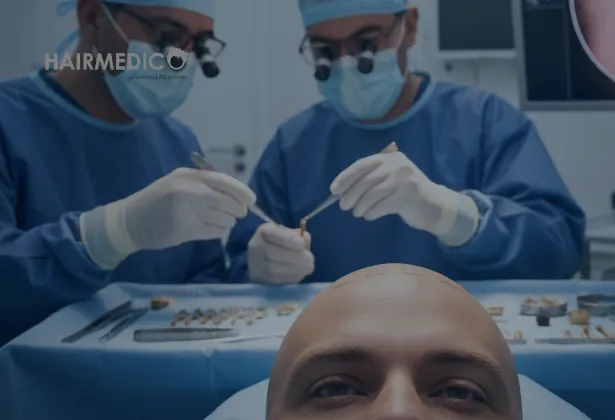
A hair transplant can be life-changing — but in the wrong hands, it can also become a lifelong regret. Every year, thousands of patients around the world fall victim to failed or poorly executed hair transplants, often performed by unqualified technicians or low-cost, high-volume clinics.
The rise of “budget” hair transplant centers has made procedures more accessible, but it has also increased the number of botched surgeries. From unnatural hairlines to scarring and poor density, these outcomes can destroy confidence instead of restoring it.
At Hairmedico, led by Dr. Arslan Musbeh, precision, ethics, and artistry are the foundation of every surgery. This guide explores how to identify, avoid, and correct bad hair transplants — and why choosing the right clinic from the start makes all the difference.
A bad hair transplant refers to any procedure that fails to achieve natural, dense, or symmetrical results. It’s not only about appearance — it’s about medical and technical failure.
Typical signs include:
Uneven or low hair density
Unnatural hairline design
Visible scarring in donor or recipient areas
Wrong graft angles and direction
Overharvested donor zones
Infections or poor healing due to lack of sterilization
These issues often stem from non-medical operators, assembly-line clinics, or inadequate preoperative planning.
In some low-cost clinics, the surgery is delegated entirely to assistants instead of licensed surgeons. This is one of the most serious ethical and medical violations in hair restoration.
Patients lured by flashy ads promising “10,000 grafts in a day” often end up with excessive trauma and poor survival rates.
Removing too many grafts from the donor zone leaves visible patches and scarring that are nearly impossible to fix.
A hairline that’s too low, straight, or dense in the wrong areas immediately reveals that the result is artificial.
Grafts are living tissue. Without constant hydration, temperature control, and minimal trauma, they die before implantation.
No aftercare guidance means infection, folliculitis, and poor graft survival.
Clinics performing 10+ patients a day sacrifice attention, sterilization, and artistry for speed.
A failed hair transplant doesn’t just affect appearance — it impacts confidence, career, and emotional well-being.
Many patients report:
Anxiety and depression after poor results
Avoidance of public or social settings
Additional costs and trauma from correction surgeries
A botched hair transplant is more than a cosmetic problem — it’s a psychological wound.
A thorough assessment of donor availability, graft direction, and scar tissue is essential.
Using Algorithmic FUE™, the density, direction, and design are recalculated with AI-based precision.
Old grafts may be removed, redistributed, or replaced.
Sometimes, a Sapphire FUE or DHI session is used for finer correction in the hairline.
PRP or exosome therapy can stimulate new growth and improve healing.
At Hairmedico, no patient is treated as a number.
Dr. Arslan Musbeh personally performs every critical stage — extraction, channel opening, and implantation.
His “One Patient per Day” philosophy ensures complete focus and precision.
Unlike high-volume clinics, Hairmedico provides:
Individualized treatment plans
Dedicated medical supervision
Multilingual patient support
Lifetime aftercare guidance
Algorithmic FUE™, developed by Dr. Musbeh, uses AI-driven density mapping and mathematical modeling to achieve perfect distribution and natural angles.
Key advantages:
Real-time analysis of graft viability
Digital pre-design of hairline symmetry
Predictive modeling for natural growth
Mathematical density calculations per cm²
In essence, it transforms hair transplantation from a manual art into a scientific discipline.
Even the best surgery can fail without proper aftercare.
At Hairmedico, patients receive:
Medical-grade shampoo and serum regimen
PRP or exosome maintenance programs
Regular online checkups with Dr. Musbeh
Detailed instructions for washing, sleeping, and protection
17+ years of global experience in FUE, Sapphire FUE, and DHI
Lecturer at Claude Bernard University Lyon 1 (DU Traitement de la Calvitie program)
International speaker and researcher in global medical congresses
Founder of Hairmedico — a clinic recognized for VIP precision and ethical standards
Exclusive “One Patient per Day” model ensuring top-tier results
Hair Transplant Turkey: Why It’s the Global Hub
Sapphire FUE Hair Transplant in Turkey
Best Hair Transplant in Turkey Reviews
A failed hair transplant can be devastating, but it’s not irreversible.
With advanced technology, expert hands, and the right approach, patients can achieve natural, lasting, and beautiful results.
At Hairmedico, every operation is built on trust, precision, and artistry — led personally by Dr. Arslan Musbeh, a global authority in hair restoration surgery.
If your hair transplant went wrong, there is hope — and science — to restore what was lost.
1. Can a bad hair transplant be fixed?
Yes. Using advanced repair techniques such as Algorithmic FUE™ and Sapphire FUE, failed transplants can often be corrected successfully.
2. How long should I wait before a repair?
Usually 12–15 months after the first surgery, once growth has stabilized.
3. Will my donor area recover?
Donor density can be preserved and improved using micro-extraction and regenerative therapies.
4. How do I know if my hair transplant is bad?
Uneven density, visible grafts, scarring, or poor direction are warning signs.
5. Why choose Hairmedico?
Because at Hairmedico, Dr. Musbeh performs only one surgery per day — ensuring maximum precision, safety, and artistry.
Dr. Arslan Musbeh, internationally recognized hair transplant surgeon in Turkey, and founder of Hairmedico, has over 17 years of experience specializing in FUE, Sapphire FUE, and DHI techniques.
He works exclusively on a one-patient-per-day VIP model, ensuring full surgical precision and personalized care.
As a lecturer at Claude Bernard University Lyon 1 for the DU Traitement de la Calvitie program, and an international speaker and researcher at global medical congresses, Dr. Musbeh combines scientific expertise and aesthetic artistry to deliver natural, permanent, and world-class hair transplant results in Turkey.
Your consultant is ready to answer your hair transplant questions, and you can also get a personalized online hair analysis.

 FR
FR
 DE
DE
 RU
RU
 ES
ES
 PL
PL
 PT
PT
 IT
IT
 CS
CS
 AR
AR
 TR
TR
 Free Hair Analysis
 Whatsapp