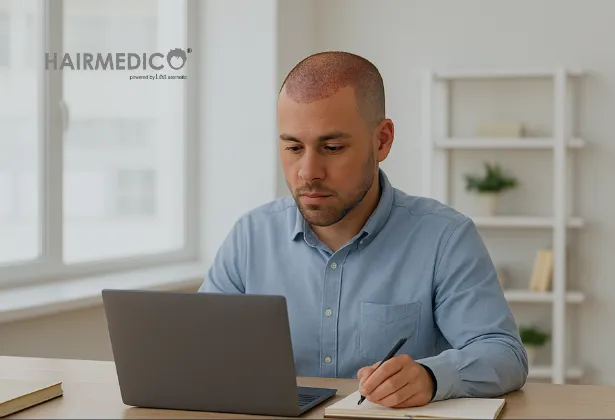
A Complete Medical Guide for Patients**
Returning to work after a hair transplant is one of the most common concerns patients have when planning their procedure. Modern techniques such as FUE, Sapphire FUE, and DHI allow for a more comfortable recovery with minimal downtime, but the exact timeline depends on several medical and lifestyle factors.
In this comprehensive guide, we break down what to expect after your procedure and how soon you can safely resume professional activities — whether your job is office-based or physically demanding.
A hair transplant is a medical procedure involving the extraction and implantation of thousands of delicate follicular units.
In the first days after the operation, grafts are still stabilizing, and the scalp is healing. Returning to work too early — especially in environments with physical exertion, dust, sweat, heat, or public interaction — may:
increase the risk of infection,
cause graft dislodgement,
prolong redness and swelling,
impact overall graft survival.
Choosing the right time to return to work helps ensure the best possible long-term results.
Hairmedico patients often experience a smooth recovery thanks to minimally traumatic surgical protocols. Below is a general medical timeline, though individual cases can vary.
Patients are advised to rest and stay at home.
Activities to avoid:
work-related stress or long screen time,
bending down frequently,
environments with dust, dirt, or smoke,
any physical activity that increases blood flow to the scalp.
At this stage:
grafts are extremely fragile,
mild swelling may appear,
redness is still visible.
➡️ Not suitable for returning to work — regardless of profession.
Most patients feel significantly more comfortable.
If your job is:
You may return to work after 4–5 days, provided:
you avoid touching or scratching the scalp,
you work in a clean environment,
you do not wear helmets, caps, or tight headgear (unless medically specified).
Some patients prefer waiting until:
redness decreases,
scabs begin to fall.
This usually happens between 7–10 days.
By this stage:
grafts are firmly settled,
scabs are mostly gone,
redness has improved significantly.
Most people comfortably resume all normal work activities except heavy physical labor.
This is the most common return-to-work period chosen by international Hairmedico patients.
If your job includes:
heavy lifting
prolonged bending
sweating
exposure to heat or sun
wearing helmets or protective headgear
→ You will need at least 14–21 days before returning.
Sweat, friction, and pressure can negatively affect graft survival — especially in the first weeks.
Every patient heals differently. The following factors may shorten or extend the recommended recovery:
DHI often requires slightly less downtime due to minimal graft exposure.
Sapphire FUE also allows quick recovery but may show visible redness for a few extra days.
People with sensitive or fair skin may experience longer redness.
Larger graft numbers = a slightly longer recovery window.
Physically heavy or public-facing professions may need additional healing days.
Sleep with your head elevated for the first 7 days to reduce swelling.
Avoid sun exposure and heat sources.
Use saline spray as instructed to prevent dryness.
Follow your washing routine exactly as prescribed.
Do not use hair fibers, sprays, or styling products until medically approved.
Your compliance with aftercare directly affects your results.
Most patients look socially presentable between:
Day 7–10 (if redness is mild), or
Day 10–14 (for larger sessions or sensitive skin).
After the second week, it is usually difficult for others to notice a procedure took place.
Returning to work depends on your job type and healing speed, but medically speaking:
Hairmedico’s one-patient-per-day medical approach, micro-surgical precision, and advanced post-operative care significantly shorten downtime and improve graft survival.
Your surgeon and medical team will provide personalized guidance based on your specific procedure.
Your consultant is ready to answer your hair transplant questions, and you can also get a personalized online hair analysis.

 FR
FR
 DE
DE
 RU
RU
 ES
ES
 PL
PL
 PT
PT
 IT
IT
 CS
CS
 AR
AR
 TR
TR
 Free Hair Analysis
 Whatsapp