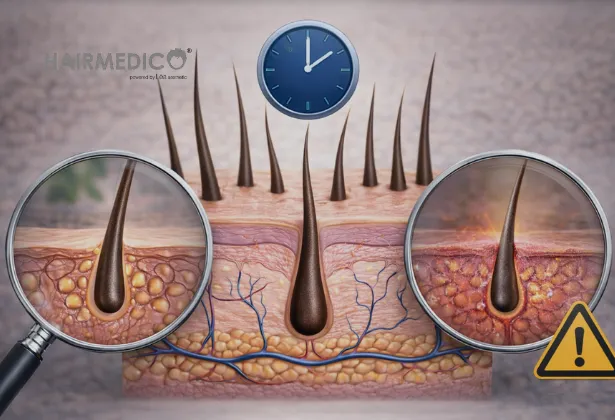
Most patients begin their hair transplant journey by comparing techniques, graft numbers, and before-after photos. Clinics promote Sapphire FUE, DHI, or high graft counts as if these factors alone define success. Yet long-term clinical data consistently show that the same procedure can yield radically different outcomes in different patients. The reason is not luck, and it is not marketing—it is scalp physiology.
In 2025, advanced hair restoration is no longer limited by surgical tools. It is limited by biology. The scalp is not a passive surface; it is a living, reactive organ that directly determines graft survival, density perception, healing quality, and long-term naturalness.
The scalp consists of multiple anatomical layers, each with unique mechanical and vascular properties. These layers regulate oxygen diffusion, inflammatory response, graft anchoring, and tissue regeneration. When follicles are implanted, the scalp reacts immediately to trauma, pressure, and ischemia. This response can either support follicular integration or actively compromise it.
Treating the scalp as a simple “implant site” is one of the most common conceptual errors in modern hair transplantation. True surgical planning begins not with the graft, but with the tissue that must sustain it for decades.
Two patients may receive the same number of grafts using the same technique, performed by the same surgeon—yet achieve dramatically different outcomes. This discrepancy is almost always biological, not technical.
Critical scalp-related variables include dermal thickness, vascular density, elasticity, sebaceous activity, chronic micro-inflammation, and prior tissue damage. When these parameters are ignored, expectations become unrealistic and results unpredictable.
Scalp thickness varies widely between individuals and even between regions of the same scalp. This factor directly affects incision depth, angulation, and density tolerance.
| Scalp Thickness | Clinical Risk | Density Capacity |
|---|---|---|
| Thin (<3 mm) | Ischemia, vascular injury | Low |
| Medium (3–5 mm) | Optimal perfusion | Moderate–High |
| Thick (>5 mm) | Resistance, fibrosis | Technique-dependent |
Thin scalps cannot safely tolerate aggressive density packing. Thick scalps require refined tools and precise depth control. Density planning without thickness assessment is guesswork, not medicine.
Scalp elasticity determines how much tissue can accommodate graft placement without compromising blood flow. Low-elasticity scalps compress microvasculature when grafts are placed too closely, reducing oxygen delivery during the critical early survival phase.
This explains a common paradox: adding more grafts can actually reduce final density if the scalp cannot physiologically support them. True density is achieved by respecting tissue limits, not by exceeding them.
During the first 48–72 hours after implantation, grafts survive solely through diffusion from surrounding tissue. Adequate microcirculation is therefore essential. Factors such as smoking, metabolic disease, chronic dermatitis, and previous surgical trauma significantly impair scalp perfusion.
Patients with compromised vascular supply often experience delayed growth, prolonged redness, higher shock loss, and uneven density. These outcomes are frequently blamed on technique, when the true cause is vascular biology.
Subclinical scalp inflammation is one of the most underestimated causes of poor hair transplant outcomes. Many patients exhibit chronic inflammatory activity without obvious symptoms. This inflammatory environment disrupts angiogenesis, interferes with follicular signaling, and delays re-entry into the growth phase.
In modern practice, inflammation control before surgery is no longer optional. It is a prerequisite for predictable, high-quality results.
FUE, Sapphire FUE, and DHI are surgical tools—not solutions. Each technique interacts differently with scalp biology, but none can override unfavorable tissue conditions. High-density DHI implantation in a rigid, inflamed scalp increases the risk of necrosis. Conversely, conservative FUE with optimal spacing may outperform advanced tools when biology is respected.
Technique selection must follow scalp assessment, not marketing trends. For an overview of technique selection within a biologically driven approach, see our detailed guide on Hair Transplant Techniques.
Despite its importance, structured scalp evaluation is still absent in many clinics. Visual inspection alone is insufficient. Advanced assessment should include dermal thickness analysis, elasticity evaluation, vascular responsiveness, sebum balance, and inflammatory indicators.
At Hairmedico, scalp-based planning is integrated into every consultation, alongside individualized hairline design and long-term donor management. You can explore this philosophy further on our Hair Transplant Overview page.
Post-operative redness, edema duration, and shock loss patterns are governed by scalp physiology, not by arbitrary timelines. Two patients following identical aftercare protocols may heal at completely different rates. Healing is not a schedule—it is a tissue response.
This is why standardized “month-by-month” promises often mislead patients and why personalized follow-up is essential.
The scalp ages just like facial skin. Elasticity decreases, vascular density declines, and dermal thickness changes over time. A transplant that ignores future scalp aging may appear dense initially but unnatural years later.
Long-term planning must account for how the scalp will behave 10–20 years after surgery, not just how it looks at 12 months. This is particularly important when evaluating Before and After Hair Transplant Results over extended timelines.
When scalp biology is overlooked, the consequences accumulate silently: reduced graft yield, donor depletion, need for corrective surgeries, and artificial patterns. Most so-called “failed” hair transplants are not failures of technique—they are failures of biological respect.
Modern hair restoration is no longer about moving follicles from one area to another. It is about managing a living biological system under surgical stress. The surgeon who understands scalp physiology controls outcomes. The surgeon who ignores it relies on chance.
Does scalp condition really matter more than graft number?
Yes. Without a supportive scalp environment, graft quantity becomes irrelevant.
Can scalp quality be improved before surgery?
In many cases, yes. Medical treatment, inflammation control, and timing can significantly improve outcomes.
Why are staged procedures sometimes necessary?
Because certain scalps cannot safely support high density in a single session.
Is scalp assessment standard practice?
Not universally. Many clinics still prioritize speed and volume over biological evaluation.
Will scalp-based planning define the future of hair transplantation?
Yes. It is already shaping advanced, long-term-focused surgical strategies.
Dr. Arslan Musbeh is an internationally recognized hair transplant surgeon and founder of Hairmedico. With over 17 years of experience, he approaches hair transplantation as a biological and aesthetic discipline rather than a mechanical procedure. Working under a strict one-patient-per-day model, Dr. Musbeh integrates scalp physiology, long-term planning, and surgical precision to achieve sustainable, natural results in Turkey.
Your consultant is ready to answer your hair transplant questions, and you can also get a personalized online hair analysis.

 FR
FR
 DE
DE
 RU
RU
 ES
ES
 PL
PL
 PT
PT
 IT
IT
 CS
CS
 AR
AR
 TR
TR
 Free Hair Analysis
 Whatsapp