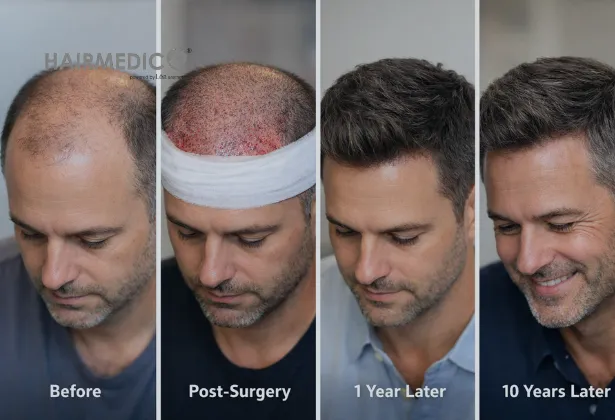
“How long will my hair transplant last?” This is the single most important question patients ask before surgery. In an industry often driven by short-term visuals and aggressive promises, longevity is the only metric that truly matters. A hair transplant is not a cosmetic illusion; it is a biological redistribution of living follicles. Understanding durability requires years of observation, not just 12-month before-and-after photos. This article presents a decade of clinical insight grounded in real follow-ups, biological fundamentals, and long-term surgical outcomes observed by Dr. Arslan Musbeh.
The short answer is simple: a properly performed hair transplant can last a lifetime. The real answer is nuanced. Longevity depends on donor genetics, surgical technique, graft handling, density planning, hairline design, patient age, progression of hair loss, and long-term scalp health. Hair transplants do not “expire,” but poorly planned transplants age badly, lose harmony, and often require correction.
Hair transplantation works because of donor dominance. Follicles harvested from the permanent donor zone—typically the occipital and parietal scalp—are genetically resistant to androgenetic alopecia. When transplanted, they retain this resistance. Biologically, these follicles are programmed to keep growing for decades. Permanence, however, does not excuse poor planning. A permanent follicle placed at the wrong angle, in the wrong location, or at an unsustainable density can still deliver an unsatisfactory long-term result.
The first year is about foundation, not the finish line. Graft survival, revascularization, and follicular cycling dominate this phase. Early shedding is normal and temporary. True growth begins around months three to four, with visible density developing by months six to nine. By month twelve, approximately 80–90% of the cosmetic result is visible. What happens in this first year determines how the transplant will look in year ten. Poor graft handling, overharvesting, or traumatic implantation permanently limits long-term density.
Between years one and three, transplanted hair thickens, gains pigmentation, and synchronizes with surrounding hair. This is when a well-designed hairline becomes truly undetectable. Clinically, many patients are surprised by continued improvement beyond the first year. From a longevity standpoint, this period reveals whether the original design respected future hair loss patterns. Aggressive, low hairlines in young patients may look impressive at year two but age poorly by year eight.
By year three, a successful transplant should appear stable. Hair grows normally, integrates seamlessly, and requires routine grooming. This phase is also when planning errors surface. Clinics that prioritized graft numbers over density and strategy often see patients return with patchiness, visible donor thinning, or hairlines that no longer fit facial aging. Density-based planning and conservative design prove their value here.
A critical misconception is that transplant longevity equals overall stability. Transplanted hair lasts; native hair may not. Androgenetic alopecia can continue progressing, especially in younger patients. Without long-term planning or medical support, islands of transplanted hair can emerge amid thinning native zones. This does not indicate transplant failure; it reflects disease progression. Longevity depends on managing both transplanted and native hair over time.
At ten years, marketing fades and reality remains. Durable transplants look natural, age-appropriate, and balanced. Transplanted hair continues to grow, may turn gray naturally, and behaves like donor hair would have if left in place. Failures at this stage are rarely biological; they are strategic—overly aggressive hairlines, donor overexploitation, or lack of foresight. When donor reserves are preserved and density is distributed intelligently, many patients require no further surgery after a decade.
Properly harvested donor hair does not fall out due to androgenetic alopecia. Exceptions exist—severe systemic illness, autoimmune scalp conditions, chronic inflammation, or traumatic technique—but these are uncommon with modern FUE and DHI performed correctly. Across long-term follow-ups, permanent loss of healthy transplanted follicles is rare when contemporary standards are respected.
The donor area is the bank account of hair transplantation. Once overdrawn, it cannot be replenished. Clinics chasing high graft counts compromise future options. Overharvested donors may appear acceptable short term but age poorly as hair thins and grays. Sustainable transplants respect extraction limits, preserve visual donor density, and keep future enhancement options open. From a 10-year perspective, donor preservation is as important as recipient density.
Hairlines should age gracefully. A hairline suitable at 25 is rarely appropriate at 45. Longevity is not about freezing youth; it is about aging well. Durable designs use micro-irregularity, appropriate recession, and density gradients that mimic natural maturation. Over time, these principles determine whether a transplant remains believable or becomes a surgical artifact.
From a longevity standpoint, execution matters more than labels. FUE delivers excellent durability when extraction is controlled and implantation angles are precise. Sapphire FUE supports healing and vascular preservation. DHI enables dense, precise placement in critical zones such as the hairline. Across ten-year outcomes, the constant of success is not the tool, but surgeon-led planning, extraction strategy, and channel design.
Transplanted hair can last a lifetime, but not every patient’s journey ends with a single procedure. Progressive hair loss, evolving aesthetics, or a desire for refinement may justify a conservative second session years later. This is not failure; it is responsible long-term management. The honest promise is lifetime growth, not immunity from change.
Longevity improves when surgery is paired with medical management to slow native hair loss. Long-term follow-up, scalp monitoring, and patient education are essential. A hair transplant should be approached as a strategy, not a one-day event.
Long-term satisfaction correlates strongly with realistic counseling and conservative planning. Patients oversold density or instant transformation are more likely to feel disappointed later—even when grafts survive. Durability is psychological as well as biological.
Common causes include aggressive hairlines, excessive graft packing in young patients, donor overharvesting, lack of future planning, and technician-driven procedures without surgeon oversight. These issues emerge slowly, which is why short-term photos cannot define quality.
A decade-old success is unremarkable. Hair grows, grays, and ages naturally. The donor looks untouched. The hairline fits the patient’s current age. This quiet normality is the true hallmark of durability.
So, how long do hair transplants really last? When performed with medical discipline, artistic restraint, and long-term strategy, they last as long as donor hair would have—often for life. Longevity is not guaranteed by graft counts or marketing claims; it is earned through planning, ethics, and respect for biology.
Do hair transplants last forever? Transplanted donor hair is permanent, but overall appearance depends on native hair progression and planning.
Does transplanted hair thin with age? It ages naturally like donor hair but does not miniaturize from genetic hair loss.
Is a second transplant normal after many years? Yes, in selected cases as part of responsible long-term care.
What threatens long-term results most? Poor planning, donor overharvesting, and unrealistic hairline design.
Dr. Arslan Musbeh is an internationally recognized hair transplant surgeon with over 17 years of experience in FUE, Sapphire FUE, and DHI. Working under a strict one-patient-per-day model, he personally designs, plans, and supervises every critical surgical step. As a lecturer at Claude Bernard University Lyon 1 and an international speaker, he integrates long-term clinical data with surgical artistry to deliver natural, durable, and age-appropriate results.
Your consultant is ready to answer your hair transplant questions, and you can also get a personalized online hair analysis.

 FR
FR
 DE
DE
 RU
RU
 ES
ES
 PL
PL
 PT
PT
 IT
IT
 CS
CS
 AR
AR
 TR
TR
 Free Hair Analysis
 Whatsapp