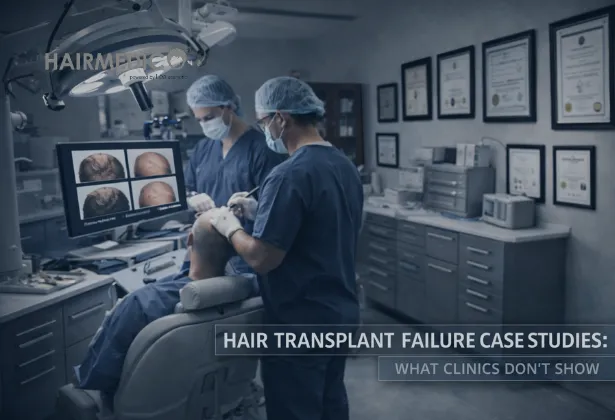
The global hair transplant industry is filled with flawless “after” photos. Perfect hairlines. Dense crowns. Smiling patients.
What you almost never see are the failed outcomes—the unnatural hairlines, empty donor areas, patchy growth, scars, and patients who quietly disappear from the clinic’s gallery.
These failures are not rare. They are simply hidden.
Every year, thousands of patients experience disappointing or irreversible results. These are not random accidents. They follow clear patterns: volume-driven clinics, technician-led surgery, algorithm-only planning, and the complete absence of long-term medical strategy.
This article reveals the most common hair transplant failure scenarios, why clinics avoid showing them, and how patients can protect themselves.
One of the most devastating outcomes is donor destruction.
In high-volume centers, grafts are extracted aggressively to reach impressive numbers. The result:
Patchy donor zones
Visible scarring
Permanent thinning at the back and sides
No reserve for future procedures
Patients often discover the damage years later, when hair loss progresses and no grafts remain for correction. Donor mismanagement is irreversible. It is the surgical equivalent of burning the bridge behind the patient.
Clinics rarely warn about this risk because it limits how many grafts they can advertise. Yet donor preservation is the foundation of every ethical treatment plan.
Understanding the real value of a procedure begins with transparency—something most price-focused marketing hides. This is why patients must look beyond headline numbers and examine what a clinic truly offers in terms of long-term strategy and protection, not just cost.
https://hairmedico.com/price
Another frequent disaster is the “Instagram hairline.”
Clinics design low, dense, straight hairlines to impress in photos, ignoring:
Facial anatomy
Age appropriateness
Natural irregularity
Future hair loss progression
The consequences:
Doll-like appearance
Wrong angulation and direction
Incompatibility with aging
An obvious surgical signature
Correction often requires graft removal, camouflage procedures, or full redesign—usually with a depleted donor.
A hairline is not decoration. It is surgical architecture that must remain believable for decades.
Some failures are invisible at first. The design looks correct. The surgery seems fine.
Then growth never comes.
Why grafts die:
Excessive out-of-body time
Dehydration during handling
Trauma during extraction
Incorrect implantation depth
Non-sterile workflow
Patients are told: “You just need another session.”
In reality, the first session failed due to technical incompetence.
Biology is unforgiving. Every follicle is living tissue. Once damaged, it cannot be replaced.
The most dangerous model is the factory clinic:
5–10 patients per day
Surgeon appears briefly
Technicians perform all stages
No medical accountability
In this system, hair transplantation becomes mechanical labor, stripped of medical judgment and aesthetic responsibility.
Typical outcomes include:
Inconsistent density
Random growth patterns
Necrosis
Asymmetry
Psychological trauma
These patients are rarely shown. They are quietly referred elsewhere.
Failure cases reveal what marketing cannot hide:
Lack of surgeon involvement
Poor planning
Ethical shortcuts
Absence of long-term thinking
Most clinics show only short-term visuals. They never publish:
3–5 year outcomes
Donor evolution
Progressive hair loss
Repair surgeries
Transparency is incompatible with volume-driven business models.
A failed hair transplant is not just cosmetic. It carries:
Financial loss
Emotional distress
Loss of trust in medicine
Reduced correction potential
Permanent donor damage
Repair surgery is complex, expensive, and biologically limited by what remains.
What many patients do not realize is that failure often becomes visible during the healing phase—when scabs fall, redness fades, and growth patterns emerge. This is where structured medical follow-up makes the difference between recovery and permanent damage.
https://hairmedico.com/post-operation
Without proper aftercare and supervision, even a technically good surgery can deteriorate.
High-integrity medical centers operate differently:
One patient per day
Surgeon-led planning and execution
Donor preservation as a core principle
Age-appropriate hairline design
Long-term loss prediction
Biological graft handling protocols
Hair restoration is treated as lifelong surgical architecture, not a cosmetic transaction.
Every decision is made with the patient’s future in mind—not just the next photo.
This is why the patient journey itself matters. From first consultation to long-term follow-up, each step must be structured, medical, and accountable.
https://hairmedico.com/hair-transplant-journey
Surgeons specializing in repair cases consistently observe repeating failure patterns. These include donor exhaustion before age 35, frontal density collapse within 3–5 years, and irreversible design errors that no longer align with the patient’s aging face.
Most repair patients were never informed that hair loss would continue. Their original surgery treated hair loss as a static condition rather than a progressive disease.
Repair surgery is not a correction of hair—it is damage control.
| Aspect | Failed Transplant | Ethical Transplant |
|---|---|---|
| Patient volume | High-volume daily cases | One patient per day |
| Surgeon role | Minimal or absent | Full planning and execution |
| Donor strategy | Aggressive extraction | Lifelong donor preservation |
| Hairline design | Photo-driven | Age-appropriate, anatomical |
| Graft handling | Fast, non-controlled | Biological protocol-based |
| Follow-up | None or minimal | Structured medical follow-up |
| Long-term outcome | Progressive failure | Sustainable aging result |
Before choosing a clinic, patients should ask:
Who designs my hairline?
Who extracts and implants my grafts?
How many patients are treated per day?
What is your long-term strategy for future hair loss?
How do you protect my donor for life?
Can you show repair cases—not only perfect results?
If a clinic cannot answer clearly, the risk is systemic.
Hair transplant failure is not random.
It follows patterns.
It emerges from shortcuts, commercial pressure, and lack of medical ethics.
The difference between success and failure is not the number of grafts.
It is the intelligence behind every decision.
Patients deserve more than density.
They deserve design, foresight, biology, and responsibility.
A hair transplant should not solve today’s mirror.
It must protect tomorrow’s identity.
Your consultant is ready to answer your hair transplant questions, and you can also get a personalized online hair analysis.

 FR
FR
 DE
DE
 RU
RU
 ES
ES
 PL
PL
 PT
PT
 IT
IT
 CS
CS
 AR
AR
 TR
TR
 Free Hair Analysis
 Whatsapp