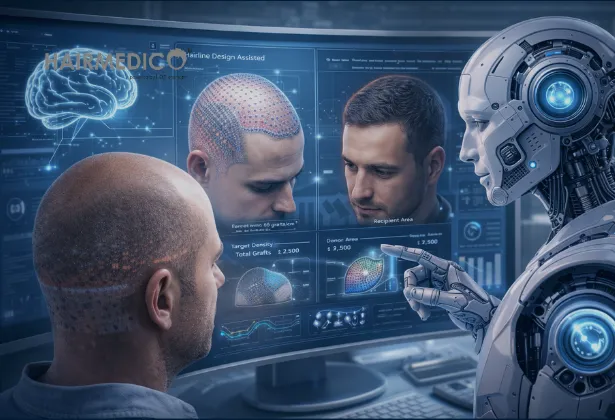
Artificial intelligence has entered the field of hair transplantation with significant momentum. Clinics advertise AI-powered diagnostics, algorithmic FUE™, robotic planning, and data-driven graft allocation as if software itself were now capable of replacing decades of surgical experience. Patients are increasingly exposed to dashboards, heat maps, density simulations, and automated recommendations, leading to a fundamental misconception: that hair transplant planning has become a computational problem rather than a biological and aesthetic one.
This assumption is incorrect.
AI can support planning. It can analyze patterns, visualize scenarios, and reduce certain types of variability. But hair transplantation is not an algorithmic exercise. It is a medical intervention performed on living tissue, guided by vascular biology, long-term donor limitations, aging dynamics, and aesthetic responsibility. No algorithm can fully account for these realities.
In my surgical philosophy, AI is a tool—not an authority. When used correctly, it enhances precision and foresight. When misunderstood, it creates dangerous overconfidence. This article examines where AI truly adds value in hair transplant planning, where it fails, and why surgical judgment remains irreplaceable beyond algorithmic FUE™.
The term “algorithmic FUE™” is largely a marketing construct. It typically refers to software systems that analyze donor areas, calculate follicular density, suggest extraction patterns, and sometimes integrate with robotic or semi-robotic extraction tools. These systems rely on image recognition, statistical averages, and predefined rules.
What they do well:
✓ Identify visible follicular groupings
✓ Estimate surface-level density
✓ Highlight extraction zones
✓ Standardize repetitive decisions
What they do not do:
✓ Understand subdermal vascularity
✓ Predict long-term hair loss progression
✓ Assess donor exhaustion risk
✓ Design age-appropriate hairlines
✓ Make ethical decisions
Algorithmic FUE™ is not intelligence in the human sense. It is pattern recognition based on past data, not biological insight.
Hair follicles are living mini-organs. Their survival depends on oxygen diffusion, microcirculation, inflammatory response, and post-implantation revascularization. AI systems do not see capillary networks. They do not feel tissue resistance. They cannot assess subtle differences in skin thickness, fibrosis, or prior trauma.
An algorithm may suggest that 4,000 grafts are “available” based on density calculations. A surgeon knows that extracting that number may irreversibly compromise the donor area over time.
This is the first critical boundary of AI: biology is not fully visible to software.
When used responsibly, AI can significantly enhance preoperative planning. In my practice, AI-assisted tools are used to support—not replace—clinical reasoning.
Proper use of AI includes:
✓ Visualizing donor distribution
✓ Simulating density outcomes conservatively
✓ Comparing multiple planning scenarios
✓ Improving patient education and communication
✓ Documenting baseline data objectively
Improper use of AI includes:
✓ Delegating graft numbers to software
✓ Letting algorithms define hairline design
✓ Ignoring future hair loss risk
✓ Treating simulations as guarantees
✓ Using AI to justify overharvesting
AI should answer questions. It should never give orders.
Hairline design is not a mathematical function. It is an aesthetic judgment shaped by age, ethnicity, facial proportions, muscle movement, and future expectations. No algorithm understands subtle irregularity, asymmetry, or the intentional imperfection that defines a natural hairline.
AI can draw lines. Surgeons design hairlines.
A mathematically perfect hairline is almost always an unnatural one.
One of the most dangerous misuses of AI in hair transplant planning is short-term optimization. Algorithms are often trained to maximize immediate coverage and density based on current images. They do not plan for:
✓ Continued androgenetic alopecia
✓ Secondary or tertiary procedures
✓ Donor preservation over decades
✓ Age-related aesthetic changes
A responsible surgeon plans for the patient at 45, not just at 28. AI does not age. Surgeons do.
Donor hair is finite. Once removed, it cannot be replaced. AI systems are indifferent to this reality. They optimize extraction patterns without moral context. Ethics must be imposed externally—by the surgeon.
Ethical donor management requires:
✓ Conservative extraction limits
✓ Uneven harvesting to avoid visible depletion
✓ Respect for future corrective needs
✓ Willingness to refuse unsafe demands
No algorithm says “no.” Surgeons must.
Density simulations are one of AI’s most powerful—and most misleading—features. They create visually compelling projections that patients often interpret as promises.
What density simulations actually represent:
✓ Statistical approximations
✓ Idealized growth assumptions
✓ Uniform survival rates
✓ Fixed lighting conditions
What they do not represent:
✓ Variable graft survival
✓ Shock loss
✓ Individual healing response
✓ Styling differences
✓ Aging effects
Simulations should educate, not persuade.
Beyond planning, AI can improve operational efficiency:
✓ Scheduling optimization
✓ Graft tracking and documentation
✓ Image comparison over time
✓ Quality control metrics
These applications are valuable because they do not interfere with medical judgment. They support systems, not outcomes.
AI is often bundled with robotic extraction platforms. This creates the illusion of autonomous surgery. In reality, robotics execute commands—they do not think.
Robots:
✓ Follow predefined paths
✓ Maintain consistency
✓ Reduce operator fatigue
They do not:
✓ Assess tissue health
✓ Adapt to unexpected anatomy
✓ Manage complications
✓ Take responsibility
Robotics amplify decisions. They do not create them.
The greatest danger of AI in hair transplant planning is not technical—it is psychological. When software outputs appear precise, they are often treated as authoritative. This can override clinical intuition and suppress critical thinking.
A surgeon who defers to AI ceases to be a surgeon and becomes an operator.
Patients often trust AI because it appears neutral. Numbers feel safer than opinions. However, algorithms are built on assumptions chosen by humans. Bias is embedded at the design level.
True objectivity in hair transplantation comes from longitudinal experience, not dashboards.
The future of AI in hair transplantation lies not in automation, but in augmentation.
Responsible AI development should focus on:
✓ Better diagnostic visualization
✓ Longitudinal outcome analysis
✓ Complication prediction models
✓ Educational tools for informed consent
✓ Surgeon-controlled customization
The goal is better decisions, not faster ones.
AI in hair transplant planning is neither a revolution nor a threat—it is a tool. Beyond algorithmic FUE™, its value depends entirely on who controls it, how it is interpreted, and whether biological reality is respected.
Hair transplantation remains a surgical art grounded in medicine, ethics, and responsibility. Algorithms can calculate. Only surgeons can judge.
In my practice, AI informs decisions—but never replaces them. Technology should make surgeons more accountable, not less.
✓ AI supports planning
✓ Surgeons own outcomes
✓ Biology overrides algorithms
✓ Ethics define success
Anything else is not innovation—it is abdication.
Your consultant is ready to answer your hair transplant questions, and you can also get a personalized online hair analysis.

 FR
FR
 DE
DE
 RU
RU
 ES
ES
 PL
PL
 PT
PT
 IT
IT
 CS
CS
 AR
AR
 TR
TR
 Free Hair Analysis
 Whatsapp