How common is hair loss in women?
Female hair loss is significantly more common than most people realise. Studies estimate that approximately 40% of women experience noticeable hair loss by age 50, rising to 55% by age 70. Despite this prevalence, female hair loss receives less clinical attention and is less openly discussed than male hair loss.

Women experience hair loss differently to men. While male pattern baldness follows a predictable Norwood progression, female hair loss is more often diffuse — affecting the entire scalp rather than progressing in a defined pattern. This makes it visually different, more psychologically distressing, and diagnostically more complex.
The 6 main types of female hair loss
1. Female pattern hair loss (FPHL / androgenetic alopecia)
The most common type — affecting approximately 50% of women who experience hair loss. FPHL is caused by a combination of genetic predisposition and androgen sensitivity. Unlike male pattern baldness, FPHL in women typically presents as a diffuse thinning over the crown and top of the scalp, with the frontal hairline usually preserved. The Ludwig scale classifies severity from Grade I (mild widening of the parting) to Grade III (advanced thinning across the crown).
2. Telogen effluvium
A diffuse, temporary shedding triggered by physiological shock — childbirth (postpartum shedding), severe illness, major surgery, crash dieting, or significant emotional stress. Telogen effluvium typically manifests 2–3 months after the trigger and resolves within 6–12 months if the underlying cause is addressed. It is the most common cause of sudden hair loss in women.
3. Traction alopecia
Caused by repeated mechanical tension on the hair from tight styles — braids, extensions, weaves, or tight ponytails. Traction alopecia classically affects the hairline and temples. If caught early, it is reversible. If the follicles are permanently scarred from chronic tension, hair transplant surgery may be required.
4. Alopecia areata
An autoimmune condition causing patchy hair loss. In women, alopecia areata can be particularly distressing as it may occur anywhere on the scalp, including the hairline, and can progress to extensive loss. Active alopecia areata is a contraindication to hair transplant classe mondiale.
5. Hormonal hair loss
Thyroid dysfunction (both hyper- and hypothyroidism), polycystic ovary syndrome (PCOS), and the hormonal changes of menopause can all cause diffuse hair thinning. Blood tests — including TSH, free T4, androgens, ferritin and vitamin D — should be part of any diagnostic workup for female hair loss.
6. Frontal fibrosing alopecia
A scarring alopecia primarily affecting postmenopausal women, causing a progressive recession of the frontal hairline and eyebrows. Requires dermatological management — active FFA is a contraindication to transplant surgery, but stable scarred areas may be suitable for restoration.
Diagnosis — getting the right assessment
Accurate diagnosis is the foundation of effective treatment. Female hair loss has multiple causes — treating the wrong one wastes time and money.
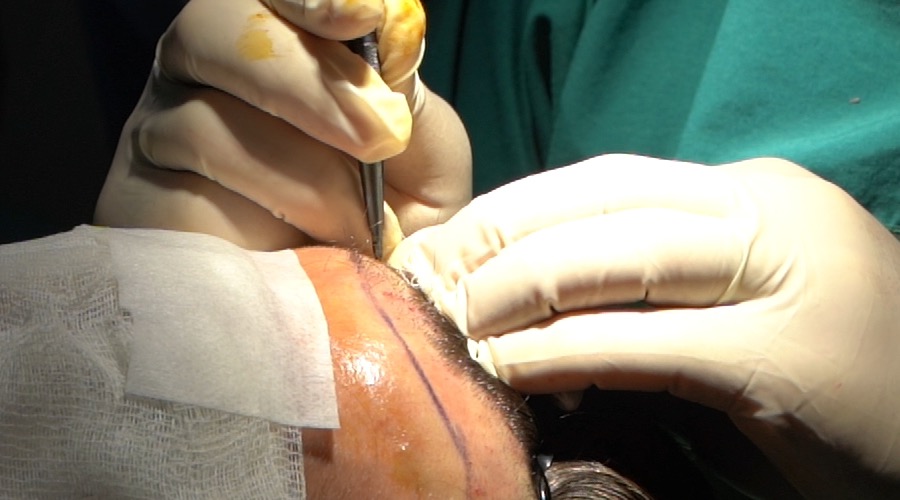
A comprehensive hair loss assessment for women should include:
- Detailed history — onset, pattern, family history, medication, recent stressors, hormonal events (pregnancy, menopause)
- Scalp examination and trichoscopy (dermoscopy of the scalp) — assessing follicle health, miniaturisation and density
- Blood panel: full blood count, ferritin, thyroid panel (TSH, T3, T4), androgens (testosterone, DHEAS), vitamin D
- Scalp biopsy if scarring alopecia is suspected
Self-diagnosis from photographs alone is insufficient for female hair loss. A proper assessment by a hair specialist or dermatologist is essential avant de pursuing any treatment.
Treatment options for women
Medical treatments
Minoxidil (5% topical): The first-line medical treatment for FPHL — the only topical treatment with strong clinical evidence for female use. Applied once daily. The 5% formulation is more effective than 2% for women. Initial shedding may occur in the first 4–6 weeks. Must be continued indefinitely to maintain effect.
Spironolactone: An anti-androgen medication used off-label for FPHL in women. Blocks androgen receptors at the follicle level. Effective in women with elevated androgens (PCOS). Not appropriate for women who may become pregnant. Requires prescription.
Finasteride: Not routinely used in women — significant teratogenic risk in women of childbearing age. May be considered in postmenopausal women under specialist supervision.
PRP: Platelet-rich plasma injections show promising evidence for FPHL and telogen effluvium. Works well as a complement to topical treatment and post-operative recovery.
Surgical option — hair transplant for women
Women can be excellent hair transplant candidates — when correctly assessed. Key considerations:
- FPHL in women is often diffuse — the donor zone may also be affected, limiting the number of available grafts
- A trichoscopic assessment of donor density is essential
- Stable loss or active medical management is required avant de surgery
- Traction alopecia with permanent scarring is an excellent indication for transplant
- Hairline lowering procedures (reducing a naturally high hairline) are suitable for women of any age
At Hairmedico, women account for approximately 15% of patients. Dr. Arslan Musbeh has specific experience in female pattern restoration, traction alopecia repair and hairline design for women.
Savoir about hair transplant for women →
When is hair transplant the right choice for a woman?
Hair transplant is appropriate for women when:
- There is localised, stable bald or significantly thinned area (traction alopecia, hairline recession, crown thinning in stable FPHL)
- Donor zone trichoscopy confirms adequate density in donor areas not affected by FPHL
- Medical treatments have been tried and are insufficient
- The cause of hair loss is not an active autoimmune or inflammatory condition
Hair transplant is not appropriate when loss is diffuse, active and progressive across the entire scalp — as the donor zone may be compromised. This is why donor assessment is more critical in women than in men.
Free consultation for women: Dr. Arslan Musbeh assesses female hair loss cases personally. Send photographs of your scalp (top, front, sides) via WhatsApp or email. Receive a clinical assessment and treatment recommendation within 24 hours.
Send 3 photographs. Personal review and graft estimate within 24 hours.